Scientist of the Day - Giacomo Beltrami

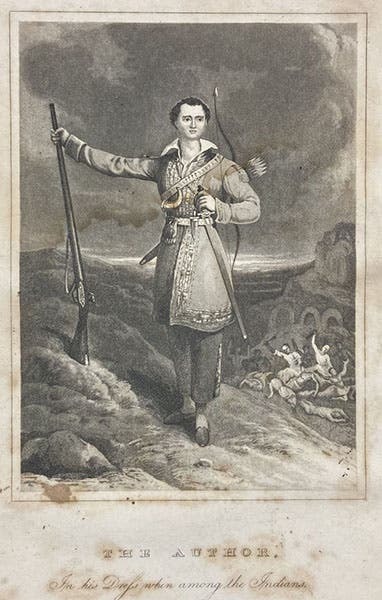
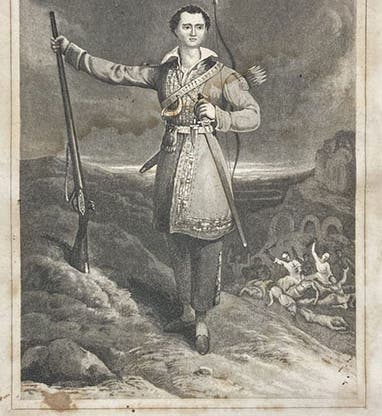
Portrait of Giacomo Beltrami, aquatint frontispiece, A Pilgrimage in Europe and America: Leading to the Discovery of the Sources of the Mississippi and Bloody River, by Giacomo Costantino Beltrami, vol. 1, 1828 (Linda Hall Library)
Giacomo Costantino Beltrami, an Italian adventurer, died Jan. 6, 1855, at age 75. Born in Bergamo, Italy, he prospered as a magistrate during the Napoleonic era, but after Napoleon fell, and his closest friend Giulia de Medici died at the age of 39, the distraught Beltrami sought solace in travel and exploration. He came to the United States and somehow wound up as part of Stephen Harriman Long's expedition to explore the Northern Mississippi in the late spring of 1823 (this was Long’s 5th and last expedition out West – he is best known for his first, which made it to the Rocky Mountains in 1820). Long and Beltrami had a falling out in Minnesota, and Beltrami went off on his own, determined to find the source of the Mississippi River.
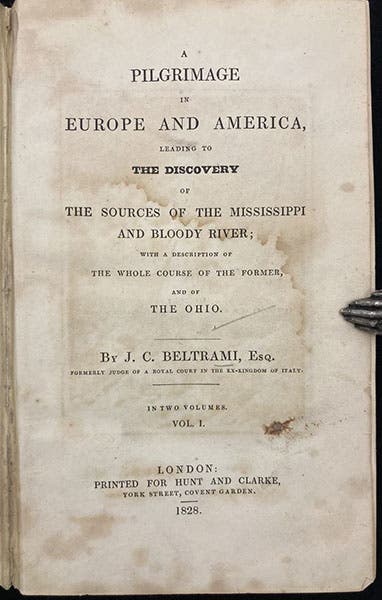
Title page, A Pilgrimage in Europe and America: Leading to the Discovery of the Sources of the Mississippi and Bloody River, by Giacomo Costantino Beltrami, vol. 1, 1828 (Linda Hall Library)
On Aug. 28, 1823, Beltrami came to a lake in northern Minnesota that he thought gave rise to the great river, and he named it Lake Giulia. It was not, in fact, the source, which lies quite a bit further north in Lake Itasca (see our post on Henry Rowe Schoolcraft), but Beltrami was convinced he had achieved his goal. He then followed the Mississippi all the way down to New Orleans, where he paused long enough to write and publish a book (in French) in 1824 about his adventures. It was translated into English in 1828 as A Pilgrimage in Europe and America, and we have this English edition in our History of Science Collection. We displayed the work in our 2004 exhibition, Science Goes West, where it was opened to the frontispiece portrait of the flamboyant Italian (first image). It is too bad that the portrait does not show the red parasol that Beltrami usually carried, as a sign of peace, which was a great source of amusement to both the expedition crew and to the native Americans they encountered.

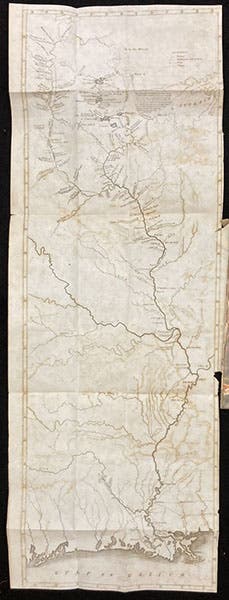
Map of the Mississippi River, engraved frontispiece, A Pilgrimage in Europe and America: Leading to the Discovery of the Sources of the Mississippi and Bloody River, by Giacomo Costantino Beltrami, vol. 2, 1828 (Linda Hall Library)
Our 1828 edition also includes a large but skinny fold-out map of the entire Mississippi River as a frontispiece to volume 2 (third image). In a detail of the top of the map, one can see, just left of center, the phrase: “Sources of the Mississippi … L. Julia” (fourth image).

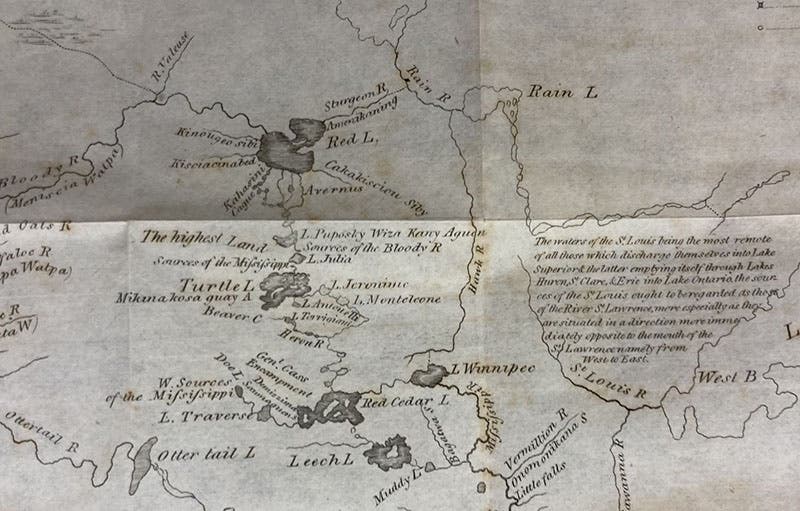
Detail of third image, showing “Sources of the Mississippi … L. Julia,” engraved frontispiece map, A Pilgrimage in Europe and America: Leading to the Discovery of the Sources of the Mississippi and Bloody River, by Giacomo Costantino Beltrami, vol. 2, 1828 (Linda Hall Library)
Oddly, Beltrami is better known to musicologists than to historians of the scientific exploration of the American west, because of two Native American musical instruments that he brought back, one a wooden flute and one a wooden whistle. These are the earliest known North American wooden flutes, and are on display in the Museo Civico di Scienze Naturali (Civic Museum of Natural Science) in Bergamo, Italy, just north of Milan.


The first Beltrami flute, made of western red cedar by natives of the American Midwest and acquired by Giacomo Betrami in 1823, now in the Museo Civico di Scienze Naturali, Bergamo, Lombardy, photo by Geoff Noman (flutopedia.com)

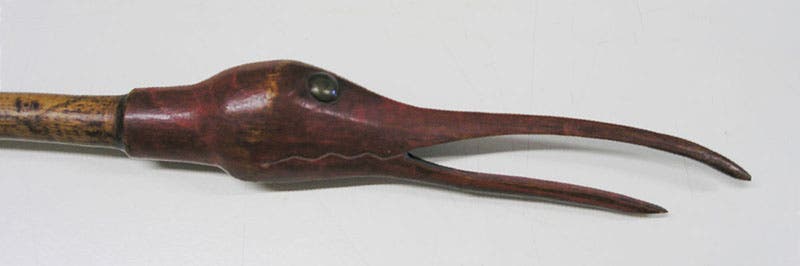
Detail of the birds-head at the foot of the second Beltrami flute, usually called the Beltrami whistle, made by natives of the American Midwest and acquired by Giacomo Betrami in 1823, now in the Museo Civico di Scienze Naturali, Bergamo, Lombardy, photo by Geoff Noman (flutopedia.com)
There is a thorough discussion of both flutes with excellent photos on a website that you may not have encountered, called Flutopedia; here is the link to the Beltrami flutes. We show here the first flute, with a fish head at the foot end (fifth image), and a detail of the bird's head at the end of the whistle (sixth image). Although Belami had nothing to do with their construction, these are both amazing instruments, especially the first flute, which was bored, not halved and gouged, from a piece of western red cedar.

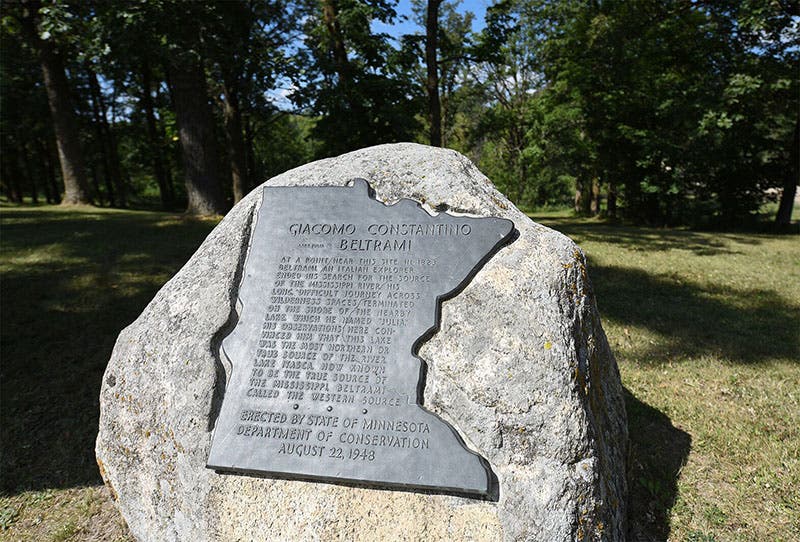
Memorial commemorating Giacomo Beltrami, Beltrami County, northern Minnesota, installed in 1948 (bemidjipioneer.com)
There is a historical monument commemorating Beltrami and his search for the source of the Mississippi in Beltrami County, northern Minnesota, not far from Lake Julia (last image). Another historical plaque can be found in Minneapolis, but as it was presented to the city by “Minneapolitans of Italian descent” and because it claims that Beltrami actually did discover the true source of the Mississippi, we do no show it here, but only provide a link.
William B. Ashworth, Jr., Consultant for the History of Science, Linda Hall Library and Associate Professor emeritus, Department of History, University of Missouri-Kansas City. Comments or corrections are welcome; please direct to ashworthw@umkc.edu.