Scientist of the Day - Jacques Ozanam

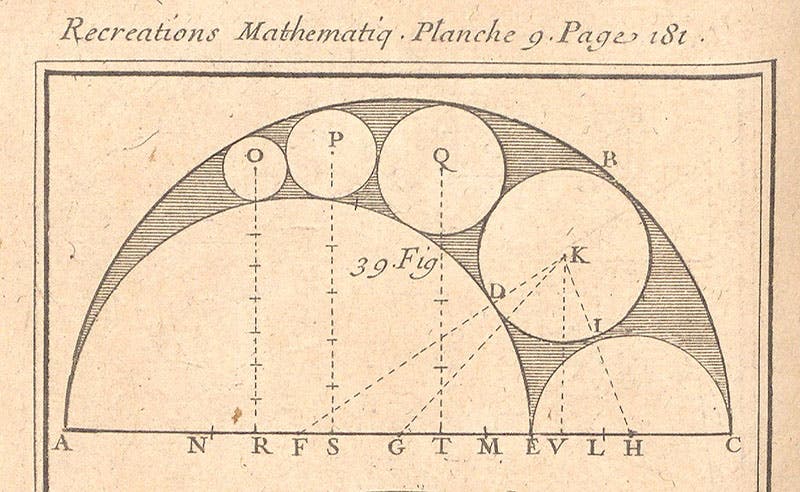
Arbelos and tangent circles, detail of plate 9, Recreations mathematiques et physiques, by Jacques Ozanam, vol. 1 (Linda Hall Library)
Jacques Ozanam, a French mathematician, was born on June 16, 1640, in Saint-Olive, in east-central France. He was a pioneer in writing mathematical handbooks for non-mathematicians, such as his popular Cours de mathematique, first published in 1695 in 5 small volumes and often reprinted and translated. We wrote our first post on Ozanam not long ago, and showed some images from a copy in our collections. On that occasion, I commented that Ozanam was even better known for his pioneering work on mathematical games and puzzles, Recreations mathematiques et physiques (1694), but that we did not have a copy in our collections, blaming myself for not recommending it for acquisition.

Title page, Recreations mathematiques et physiques, by Jacques Ozanam, vol. 1 (Linda Hall Library)
Fortunately, Bruce Bradley, our Acting Librarian for Rare Books, and my colleague here for many years before he retired and then recently unretired, read my mea culpa and took me off the hook by finding an excellent copy on the market and then buying it. So that lacuna has been filled, and today, we show a few pages from our recent acquisition.

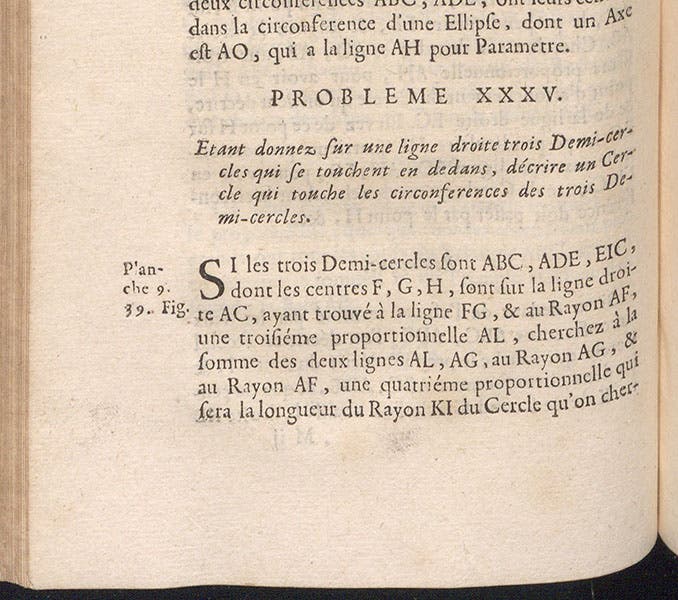
Problem 35, concerning the arbelos, Recreations mathematiques et physiques, by Jacques Ozanam, p. 180, vol. 1 (Linda Hall Library)
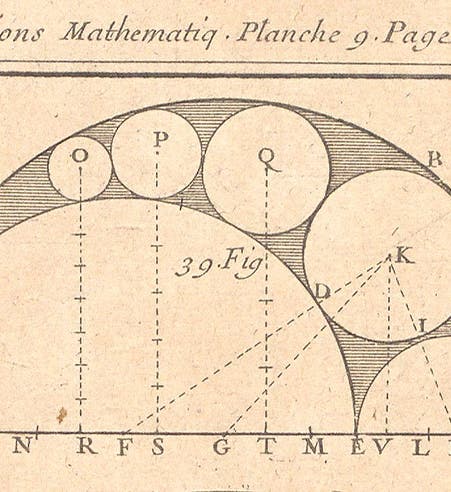
There are many clever mathematical problems presented in these two volumes. I am going to discuss just one of them, problem 35, which is illustrated by an engraved plate, plate 9, in volume one (fourth image). It shows two versions of a geometric figure known, since Archimedes, as an arbelos. We also show the first of two pages of text that discuss problem 35 (third image).

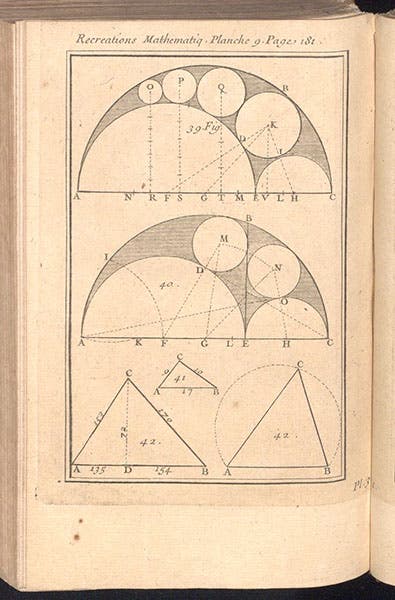
Two diagrams of an arbelos with tangent circles, plate 9, Recreations mathematiques et physiques, by Jacques Ozanam, vol. 1 (Linda Hall Library)
The arbelos is the shaded area formed by two smaller circles of different sizes, nestled inside a larger circle so that all three are just touching. The shaded area resembles a shoe-makers knife, called an arbelos.
One of the interesting things you can do with a geometric arbelos is insert a train of diminishing tangent circles that fill the shaded area going left, as Ozanam has done in his figure 39 (first image). These circles have interesting properties; for example, the circumference of each tangent circle is related to its distance from the large circle’s diameter by a simple equation. And there are lots more oddities about the arbelos.

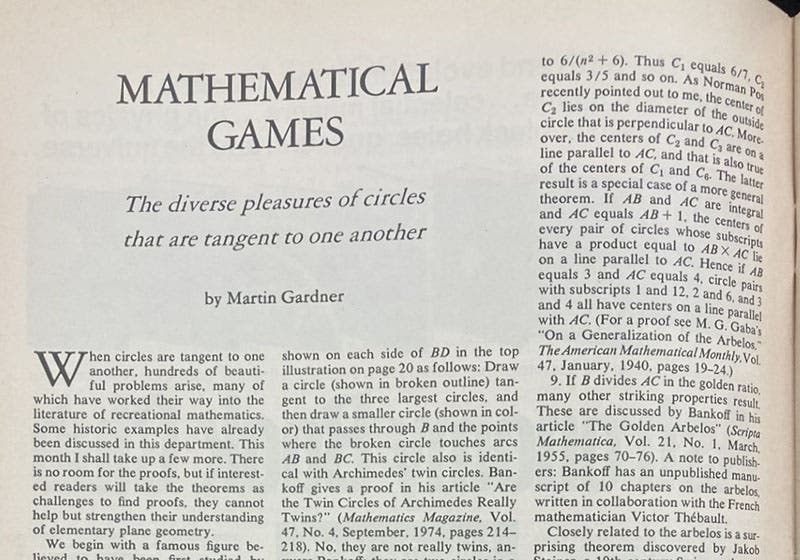
Beginning of the column “The divese pleasures of circles that are tangent to one another,” by Martin Gardner, Scientific American, January 1979, p. 18 (author’s collection)
Plate 9 caught my eye when I leafed through volume 1, because it looked quite familiar, although at first I did not know why. I guessed that Martin Gardner had written a "Mathematical Games" column on the arbelos for Scientific American. I could not find it in any of Gardner's book-collections of columns, all of which I own, but a simple Google search for "Gardner" and "arbelos" turned it up, in the January 1979 issue of Scientific American, page 18 (fifth image). And there, on page 20, were two diagrams of nests of kissing circles, looking like they came right out of Ozanam (sixth image). Which they hadn't – they had been filtered through dozens of books on recreational mathematics, and Gardner did not mention Ozanam in his column. But I suspect that Ozanam was the first to pull the attributes of the arbelos from the works of the ancient mathematician Pappus of Alexandria, where it was first discussed (Archimedes' account does not survive) and include it in a modern compilation, his Recreations mathematique. The world of recreational mathematics is, in one way, very extensive, and in another way, quite small.

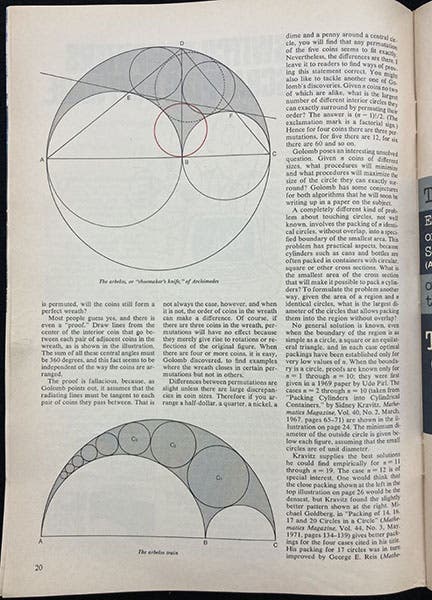
Two diagrams of an arbleos, “The diverse pleasures of circles that are tangent to one another,” by Martin Gardner, Scientific American, January 1979, p. 20 (author’s collection)
In the 10 weeks since I first wrote on Ozanam, I have not turned up a portrait, and probably there is not one to be found. So I will remember him by the arbelos.
Volume 2 of Ozanam's Recreations became available to me only at the last minute, so I will defer discussion to another time. It contains mostly problems in recreational physics, with some engaging illustrations, such as one that shows a carriage, powered by pedals operated by a footman. It also has an appended treatise on clock-making, not by Ozanam, but by a man named Martinelli. Since Martinelli had published it himself in 1669 (a book that we have in our collections), it is a mystery right now why Ozanam included it in a volume on recreational physics. Perhaps the mystery will be solved by the time we write a third piece on Ozanam.
William B. Ashworth, Jr., Consultant for the History of Science, Linda Hall Library and Associate Professor emeritus, Department of History, University of Missouri-Kansas City. Comments or corrections are welcome; please direct to ashworthw@umkc.edu.