Scientist of the Day - Jonas Salk

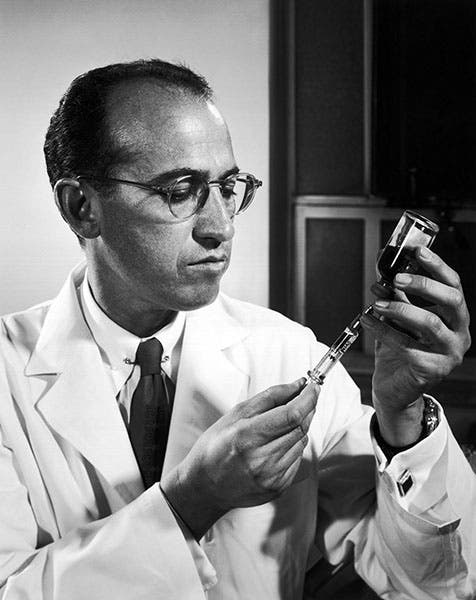
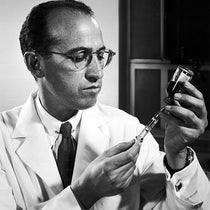
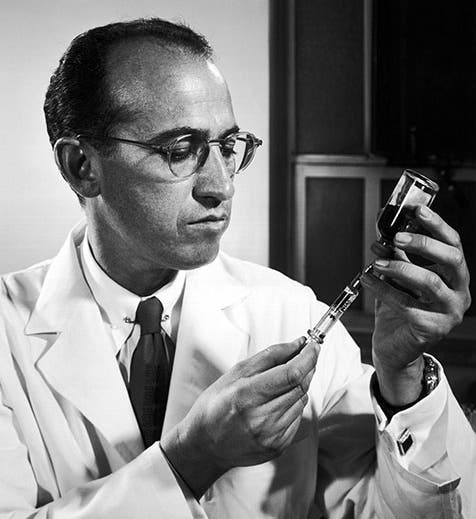
Jonas Salk in the lab, undated and unattributed photograph (findagrave.com)
Jonas Salk, an American medical scientist and researcher, was born Oct. 28, 1914, in New York City. His parents were working-class immigrant Jews. Salk was able to attend one of those wonderful preparatory schools for poor but intelligent immigrants that only New York City seems to have had in the early part of the century, this one the Townshend Harris Hall Prep School. It readied students for City College of New York (CCNY), the only college that immigrant children could really aspire to, especially if they were Jewish.
Salk decided early on that he wanted to go into medicine, but he never desired to practice as a physician, and he never would do so. He wanted instead to cure diseases, and he kept that goal in front of him his entire life. Salk attended medical school at NYU, and there became interested first in bacteriology, and then in virology, the study of viruses. The country had recently gone through a devastating influenza epidemic, and interest in finding a vaccine to protect against the flu virus in the 1930s and 40s was intense, and ultimately successful. Salk helped discover some flu virus variants during World War II, against which vaccines were developed.
After the War, Salk moved to the University of Pittsburgh Medical School, where he set up a virology lab and attracted like-minded staff. Soon the National Foundation for Infantile Paralysis came calling, wanting Salk to determine how many varieties there were of the virus that causes poliomyelitis, commonly known as polio, as a first step to developing a vaccine. Polio was then the childhood scourge of the country and incurable. But it was preventable, if a vaccine could be developed. Salk turned his Pittsburgh lab into a polio laboratory and worked intensely at creating a vaccine. As everyone knows, because Salk is the most famous virologist in history, he was successful. The first vaccines were developed in 1953, fine-tuned and tested in massive trials in 1954, and released in 1955. Thus began the most successful vaccination program in history. It came just in time for millions, but was too late for me and my sister, both of us contracting polio in 1951. Fortunately, our paralysis was temporary, and the only long-term effect has been a certain grumpiness when in the presence of an anti-vaxxer.

Jonas Salk addressing the Center for Disease Control, photograph, 1988 (Wikimedia commons)
In less than a decade, polio was eradicated in the United States. Salk was soon as recognizable as Marilyn Monroe and Charlie Chaplin. Salk did not wear his fame well and often complained about the public attention that made his post-vaccine life so difficult. But the fact is, this same fame brought him his own state-of-the-art research lab, the Salk Institute for Biological Studies, which was built for him from scratch in La Jolla in greater San Diego in 1963. Salk directed the Institute until his death in 1995 at the age of 80. He hoped as a final project to find a vaccine to prevent AIDS, but was not successful. However, he did attract prominent researchers to the Institute, including Francis Crick, the co-discoverer of the DNA double helix, and Sydney Brenner, an engaging nematode expert and Nobelist whom we shall have to profile one day.

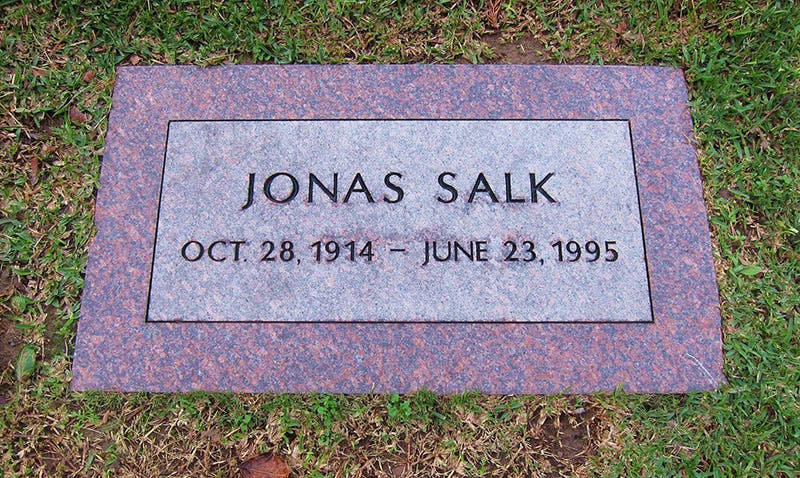
Tombstone of Jonas Salk, El Camino Memorial Park, San Diego (findagrave.com)
Salk was buried in El Camino Memorial Park in San Diego. As befits his fame, his tombstone is simple and unostentatious (third image). His papers and archives are in the Geisel Library at UCSD, which gives us an excuse to include a photo of that marvelous structure, which I failed to do when writing about Dr. Seuss not so long ago (last image). There has been a movement afoot to change the name of the Library, in view of Theodore Geisel’s sometimes unsavory views on race. They probably will not make a name change, since Audrey Geisel gave UCSD many millions of dollars to name it after her husband, but should they do so anyway, then the Jonas Salk Library might be a popular choice for a replacement name.

Geisel Library, University of California, San Diego, where the papers and archives of Jonas Salk are deposited (Wikimedia commons)
William B. Ashworth, Jr., Consultant for the History of Science, Linda Hall Library and Associate Professor emeritus, Department of History, University of Missouri-Kansas City. Comments or corrections are welcome; please direct to ashworthw@umkc.edu.