Scientist of the Day - Pliny the Elder

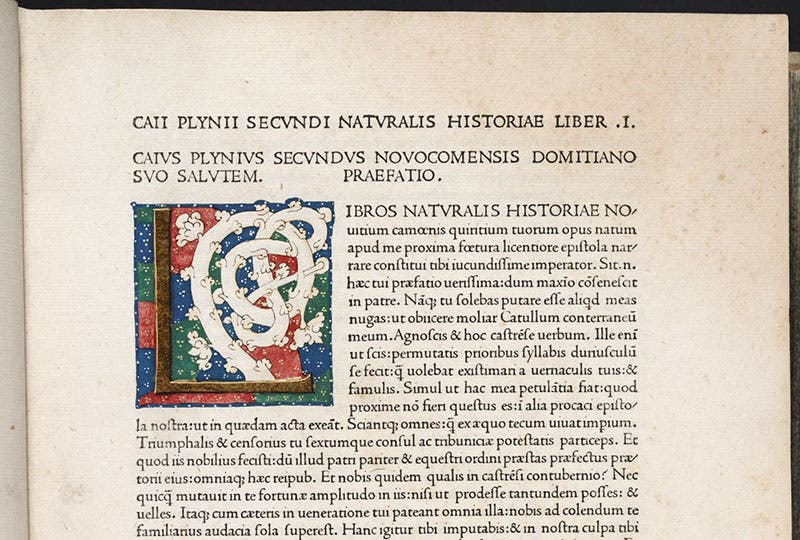
First page, detail, with illuminated initial “L” to begin book 1, Naturalis historia, by Pliny the Elder, Venice, Nicolas Jenson 1472 (Linda Hall Library)
Gaius Plinius Secundus, better known as Pliny the Elder, was a Roman statesman, military officer, and encyclopedist in the early Roman Empire. He was born around 23 CE in Como in north Italy and died on the Bay of Naples in 79 CE. He is best known for his Natural History, an encyclopedia in 37 books (not volumes), that was still shaping views of the world 1500 years later.

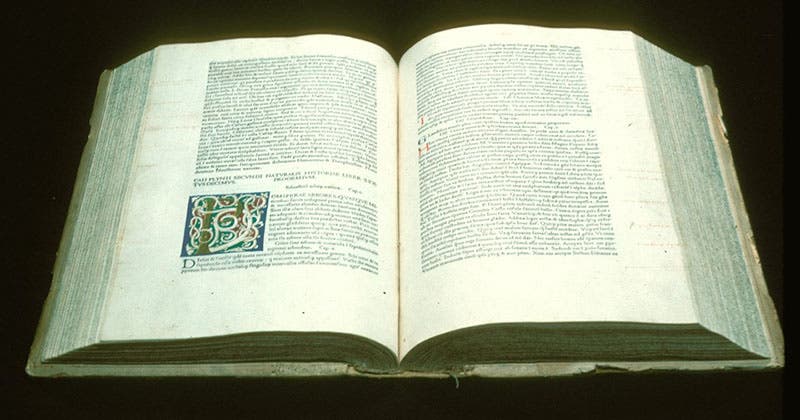
Two-page spread, beginning of book 16, Naturalis historia, by Pliny the Elder, Venice, Nicolas Jenson, 1472 (Linda Hall Library)
Pliny started out as a Roman army officer, serving in the infantry, then cavalry, in the two Germanys (upper and lower). He worked his way up through the Imperial civil service, working for the emperors Vespasian and Titus, and surviving Nero by laying low. Mostly he served as procurator for various provinces in Spain, southern France, and north Africa. He wrote on many subjects, such as the German wars, but only the Natural History survives.


Blind-tooled, alum-tawed pigskin half-binding, Naturalis historia, by Pliny, the Elder, Venice, Nicolas Jenson, 1472 (Linda Hall Library)
The Natural History is a true encyclopedia, in that it covers everything. Each of the 37 books has a different subject: astronomy, geography, land animals, mining, agriculture, sculpture. Pliny compiled it by reading books. Or should we say, he had books read to him by servants – in the bath, at meals, in his litter when on the go. Pliny would mentally digest what he heard and dictate a summary to a scribe, who would write it down. He filled scores of volumes with these notes, and from them, in the years before 77 CE, he compiled his encyclopedia.

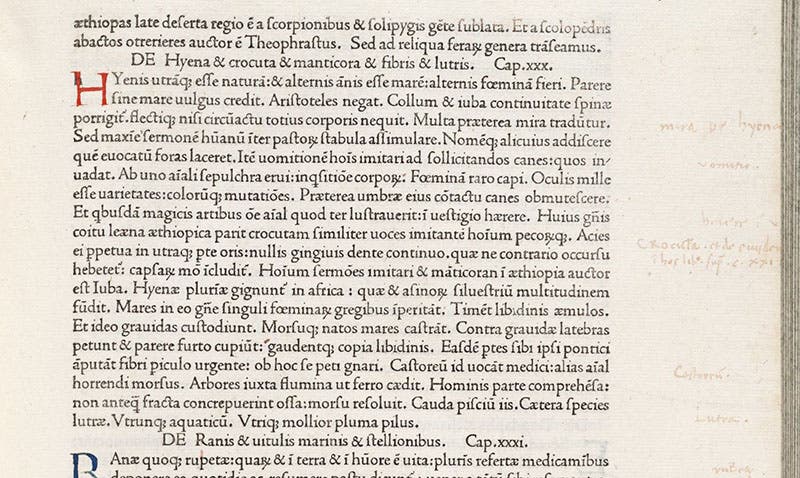
Passage describing the hyena, Naturalis historia, by Pliny the Elder, Venice, Nicolas Jenson, book 8, chap 30, 1472 (Linda Hall Library)
What does a Plinean article look like? I used to read my classes the entire article on the hyena, which is one paragraph long (fourth image). From it, you would learn that the hyena is bisexual, becoming male and female in alternative years; that it cannot turn its neck; that it imitates the sound of vomiting, to attract dogs, which it pounces upon; and that it causes any animal at which it gazes three times to be rooted to the spot. There is no description of the hyena; no attempt to classify it; nothing about its anatomy (except for the stiff neck). It would be easy to dismiss this as uncritical armchair natural history, which it was. Bu it is also an invaluable record of how one society viewed animals (and everything else) through the eyes of their culture.

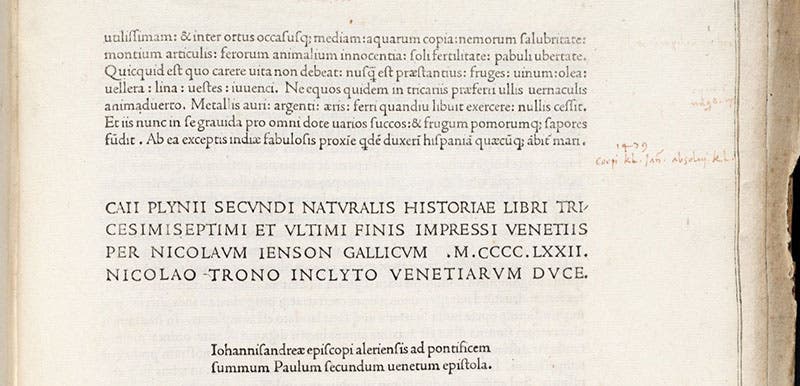
Colophon near end, stating that the book was printed in Venice by Nicolas Jenson in MCCCCLXXII (1472), Naturalis historia, by Pliny the Elder (Linda Hall Library)
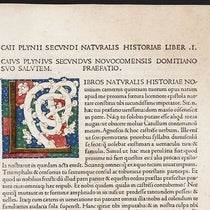
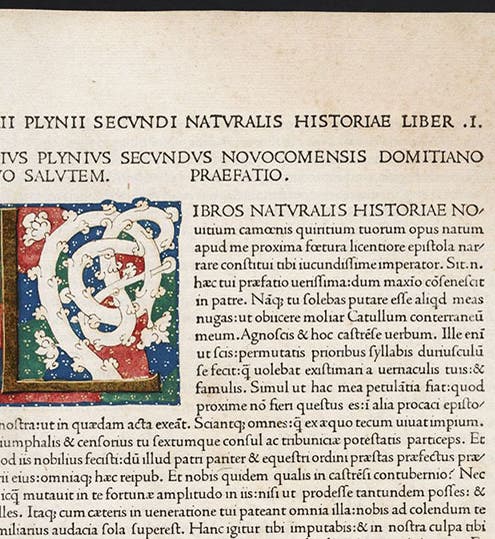
We have several early editions of Pliny's Natural History in our collections, but we are rather partial to a robust folio, half-bound in blind-rolled pigskin over thick boards (third image), that was printed by Nicolas Jenson in Venice in 1472. It is, indeed, our earliest printed book. The first 20 of the opening letters for the 37 books are illuminated in blue, green, and red ink. and gold leaf (first image).
We know so much about Pliny the Elder, and his work habits, because he had a nephew, Pliny the Younger, who wrote a biography of his uncle, and ensured that the Natural History was published when Pliny met his untimely demise in the year 79 CE. The nephew tells us what happened.

The Eruption of Vesuvius, oil on canvas, by Pierre-Henri Valenciennes, Musée des Augustins de Toulouse, 1813, depicting the death of Pliny the Elder (Wikimedia commons)
Mount Vesuvius erupted catastrophically, either in August, or in the fall, of 79 CE (burying Pompeii in the process), and Pliny the Elder was stationed at a port in the Bay of Naples at the time, leading a fleet of Roman ships. The ships crossed the Bay to Stabiae, Pliny included, to rescue people stranded there, but ash and lava rained down, and the area was filled with fumes, and Pliny, who was obese and possibly asthmatic, succumbed to the gases and died. He was about 56 years old. His death was depicted dramatically in 1813 in a painting by Pierre-Henri Valenciennes, about whom we once wrote a post (last image).
Pliny's Natural History was the most influential work of its kind throughout the Middle Ages and the Renaissance (unlike Aristotle’s History of Animals, it was never lost, and did not have to be recovered). On many subjects, such as Roman sculpture, and mining, Pliny is our only reliable source. You can buy your own copy of the Natural History, 10 volumes in Latin and English, published by the Loeb Classical Library. I bought my set when I was in grad school and had no money; fortunately, it cost only $5 per volume back then, and I have consulted it regularly ever since. Volume 3 of my set, which contains the description of the hyena that I read aloud so often, is considerably more battered than the rest.
Or, you may consult our 1472 edition, which is available online, but is much more magnificent in person.
William B. Ashworth, Jr., Consultant for the History of Science, Linda Hall Library and Associate Professor emeritus, Department of History, University of Missouri-Kansas City. Comments or corrections are welcome; please direct to ashworthw@umkc.edu.