Scientist of the Day - Chandra Beinaree



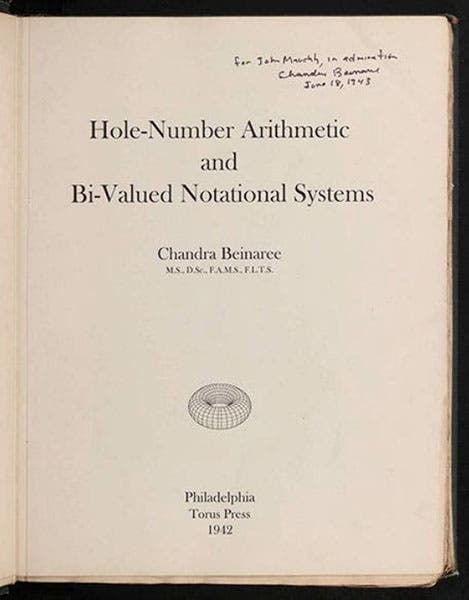

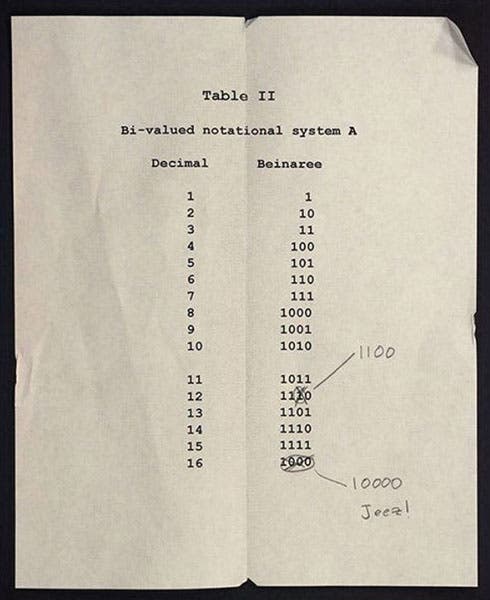





Chandra Beinaree, an Indian mathematician working in the United States, was born Apr. 1, 1902. In 1940, Beinaree began a deep investigation of hole theory. He was inspired by the classic puzzler: if you can dig 2 holes in 4 hours, how many holes can you dig in one hour? The impulsive will answer, half-a-hole, but the correct answer is one, since a hole either exists or it doesn’t--you can’t have half a hole. Similarly, if you cut a donut in half, you don’t end up with half a donut hole; the donut hole disappears as soon as you cut into it. Deliberating on such conundra led Beinaree to develop a sophisticated system of hole-number mathematics, with which he could predict the outcome of every instance in which holes are added, subtracted, or divided, so that the answer is always either 0 or 1, and he published an account of his work in 1942, as Hole-Number Arithmetic and Bi-Valued Notational Systems (see second image above).
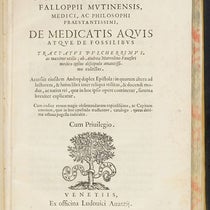
As it happened, in 1943, the US Army was designing the first digital computer, the ENIAC, and they were looking for a number system that could describe the state of thousands of vacuum tube switches, all of which were either on or off, that is, had a value of 1 or 0. The Beinaree system was just what they were looking for, and they used it to develop the ENIAC programming. The ENIAC and its new digital code were announced to the world on Feb. 15, 1946, but the Army changed the name of the operating system to the “'binary" system, perhaps to conceal its non-American origins. For a similar reason, the government appears to have bought up the complete printing of Beinaree’s book and suppressed it, making Hole-Number Arithmetic the greatest rarity in the history of computer science. Only two copies are known to exist; one is in the Linda Hall Library, a presentation copy to John Mauchly, the designer of ENIAC. The other is currently being offered for sale by the eminent New York dealer Jonathan Hill, and is a presentation copy to John von Neumann, the father of the modern computer [add link here when available]. Our copy also contains a proof sheet of a table of Beinaree numbers, laid in, which Beinaree had corrected, apparently with some exasperation (third image above).
Beinaree, denied credit for his “bi-valued notational system”, moved to Woods Hole, Mass., and continued to study hole architecture through the 1950s, turning his attention to agriculture, where he discovered, or at least claimed, that crops planted in holes were more nourishing than those grown by more conventional methods; we see here one of his test plots (fourth image above). In 1962, Beinaree founded Hole Foods, featuring food products raised from hole plantings; we have a photograph of one of the first stores opened to the public (fifth image above). He lost control of the franchise when he went insane, and the name was changed as the company went in other directions.
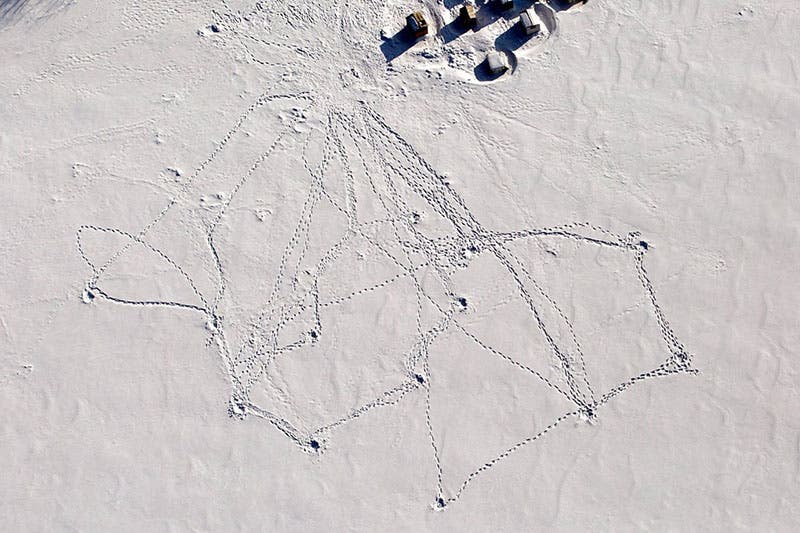
Beinaree’s sanity deserted him in 1964, when he heard about the newly discovered black holes. Apparently the thought of a hole having attributes like color unhinged him, and the claim that a black hole could be “hairy” sent him completely around the bend. He spent two years at a sanitarium in Jackson’s Hole, Wyoming; a photograph of his confused wanderings at his last hole project on a glacial lake is a sobering reminder of the fragility of the human psyche (sixth image above). Beinarees died in 1966, at the age of 64. Interestingly, his age at his death, in the binary system, was 1000000. It is too bad he couldn’t appreciate the moment when his personal odometer rolled over.
William B. Ashworth, Jr., Consultant for the History of Science, Linda Hall Library and Associate Professor emeritus, Department of History, University of Missouri-Kansas City. Comments or corrections are welcome; please direct to ashworthw@umkc.edu.