Scientist of the Day - Henry Augustus Rowland


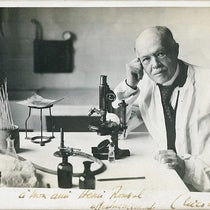
Portrait of Heny A. Rowland, undated photograph, Johns Hopkins libraries (library.jhu.edu)
Henry Augustus Rowland, an American physicist, died Apr. 16, 1901, at the age of 52. He was born on Nov. 27, 1848, in Honesdale, Pennsylvania, in the northeast corner of the state, to a minister father and a New York City society mother. He was smart, did well in school, and was inclined from an early age to experimental science, which would be his mainstay for the rest of his life. Rowland attended Rensselaer Polytechnic Institute (RPI), where he studied physics, graduating in 1870.
Rowland worked for the railways for a few years, then taught physics in Ohio, before returning to teach at RPI. It is not clear what Rowland did to distinguish himself in the six years after graduation – he was unable to get his papers published in the U.S. – but something he sent to James Clerk Maxwell, the brilliant physicist at Edinburgh, excited that master of electro-dynamics, and Maxwell arranged to have Rowland's papers published in Great Britain. Rowlands was working, at the time, on the value of the ohm, the unit of electrical resistance. British physicists must have read and liked his work, because when the newly founded Johns Hopkins University came inquiring of Britons in 1875, wondering whom they should hire to fill their new chair of physics, they were told to look in their own backyard – the best man available was right there in Troy, New York. Hopkins offered Rowland the job, Rowland accepted, and he taught at Hopkins from 1876 until his death in 1901, becoming the best experimental physicist in America within 6 years.

Henry A. Rowland wtih his dividing or ruling engine, undated photograph, Popular Science Monthly, Sep. 1903 (Wikimedia commons)
Rowland’s most important contributions to physics were his diffraction gratings. Spectroscopy, by the 1870s, had become a significant part of astronomy, using the dispersive effects of a prism to break down the light from the Sun and stars into its constituent waves and revealing the chemical composition of stars and Sun. Prisms however were crude instruments and did not help determine the actual wavelengths of light. It was then found that ruled gratings of glass or metal had the same dispersive effect, breaking down light into its constituent colors, with the additional advantage of allowing the calculation of wavelengths. The difficulty with gratings is that, to be effective, the gratings had to be ruled with extreme precision, so that the ruled lines were exactly the same distance apart.


A ruling or dividing engine, for making diffraction gratings, built to the specifications of Henry A. Rowland, before 1882, given by the Dept. of Physics at Johns Hopkins University to the National Museum of American History, Washington, D.C. (americanhistory.si.edu)
Rowland learned how to make a dividing or ruling engine that would engrave a grating with the necessary precision. To disperse light, the rulings on a grating have to be about a wavelength apart, which means that a diamond point has to engrave lines that are about 30 millionths of an inch apart. As you can imagine it takes a dividing engine a long time to make a grating with hundreds of thousands of precisely inscribed lines. But by 1882, Rowland was producing concave reflective gratings that were the finest in the world, and brought a new precision to solar spectroscopy. Rowland himself published a photographic alas of the spectrum of the Sun in 1888, which we do not have in our collections. It was the definitive reference source on the solar spectrum for 30 years.

Portrait of Henry Augustus Rowland holding a diffraction grating on his lap, oil on canvas, by Thomas Eakins, 1897, with a hand-painted frame by Eakins, Addison Gallery of American Art (Wikimedia commons)
Having just written a notice about Emmy Noether, where we noted, as everyone does, the tragedy of her early death at age 53, I cannot help but wonder why no one makes the same observation about Rowland, who was one year younger than Noether when he passed away. Indeed, it is hard to even find the cause of his death, except that he had known for several years that it was coming. Perhaps early death does not seem so tragic, when your life has been a rewarded one (as Noether's was not), and you have been allowed to articulate and develop your one great idea, as Rowland was. Whatever the reason, Noether's life is deemed to have been cut short by cruel fate; Rowland's has not. Life (and death) is strange.
William B. Ashworth, Jr., Consultant for the History of Science, Linda Hall Library and Associate Professor emeritus, Department of History, University of Missouri-Kansas City. Comments or corrections are welcome; please direct to ashworthw@umkc.edu.