Scientist of the Day - John Smeaton
_-_Shipping_off_the_Eddystone_Lighthouse.jpg)

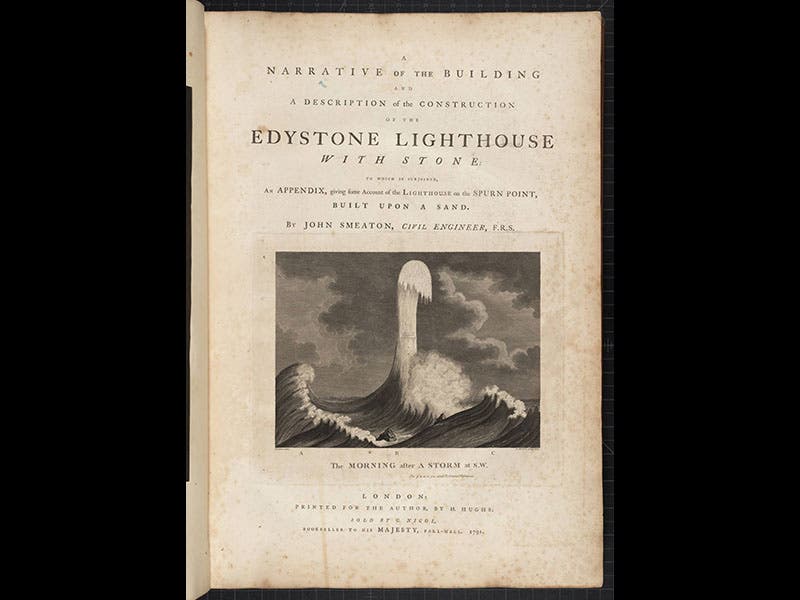
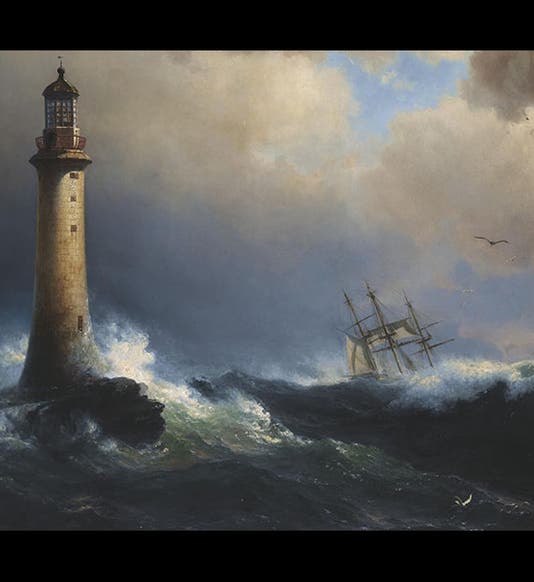
John Smeaton, a British civil engineer, was born June 8, 1724, and is famous for designing and building the third Eddystone lighthouse. The Eddystone rocks sit in the western English Channel, just south of Plymouth, and present a considerable hazard to shipping. The first lighthouse was built there in 1698, but it washed away within 5 years. A second was built in 1708, and was much sturdier, but it was made of wood, and it burned down in 1755. The third lighthouse, designed by Smeaton, opened in 1759. Smeaton’s lighthouse was built entirely of Portland stone and granite; the bottom course of stone was dovetailed into the underlying rock, and each higher course was interlocked with the stones below, the stones on its own level, and the level above. The result was an extremely sturdy structure, and it survived-and successfully warned approaching ships–for 130 years, and even then, it was the rock beneath, and not the lighthouse, that began to fail. A fourth lighthouse was built on a nearby rock in 1882. Smeaton published a large folio volume describing his lighthouse in 1791 (second image), with beautiful engravings showing all the stages of construction. We see above the first six courses, providing the foundation (third image); a view of the construction of course 16 (fourth image); and the completed lighthouse in section (fifth image). The volume also has a portrait of Smeaton (sixth image). A second and enlarged edition was published in 1793, one year after Smeaton’s death. We exhibited both of these volumes in our Centuries of Civil Engineering exhibit in 2002. The painting (first image) is by the nineteenth-century Danish marine artist Vinhelm Melbye.