Scientist of the Day - Ephraim Chambers

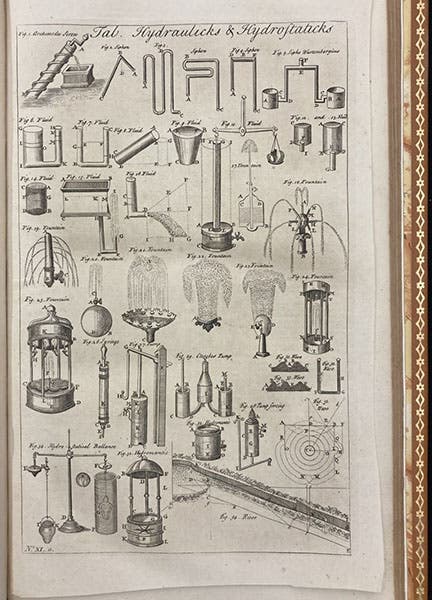
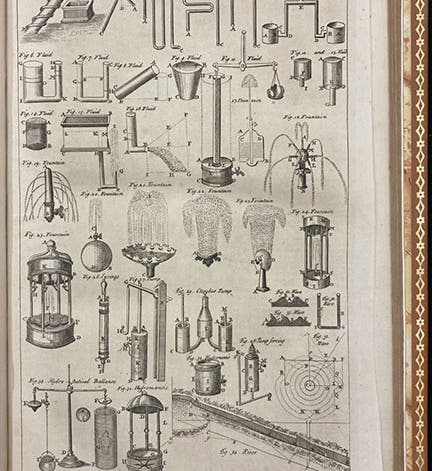
Illustrations for the article on “Hydraulics”, Cyclopædia, or, an Universal Dictionary of Arts and Sciences, by Ephraim Chambers, 7th ed., vol. 1, plate 11, 1751-52 (Linda Hall Library)
Ephraim Chambers, an English encyclopedist, died on May 15, 1740. Born around 1680 in Kendal in the Lake District of northwest England, he started his working life in London as an apprentice to John Senex, the map maker. Somehow, Chambers generated the idea that he wanted to compile an encyclopedia of the arts and sciences, not an obvious notion in 1710, since there were no encyclopedias at that time. Probably he was inspired by the Lexicon technicum of John Harris (1704-10), which was more of an expansive dictionary than an encyclopedia, but Chambers would borrow from it extensively.

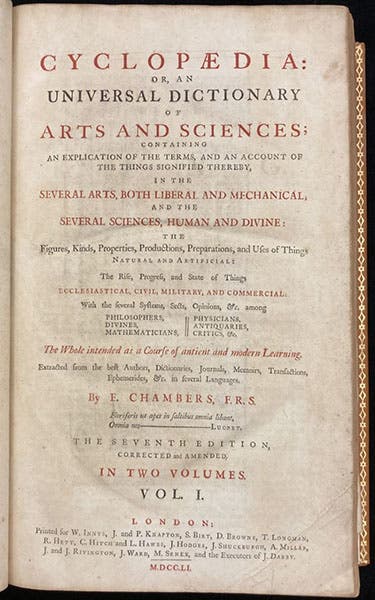
Title page, Cyclopædia, or, an Universal Dictionary of Arts and Sciences, by Ephraim Chambers, 7th ed., vol. 1, 1751-52 (Linda Hall Library)
The only other possible precedent for Chambers' project was the Dictionnaire critique et historique (1697) of Pierre Bayle, but that was really a biographical dictionary, and Chambers would deliberately avoid biographical entries in his venture.

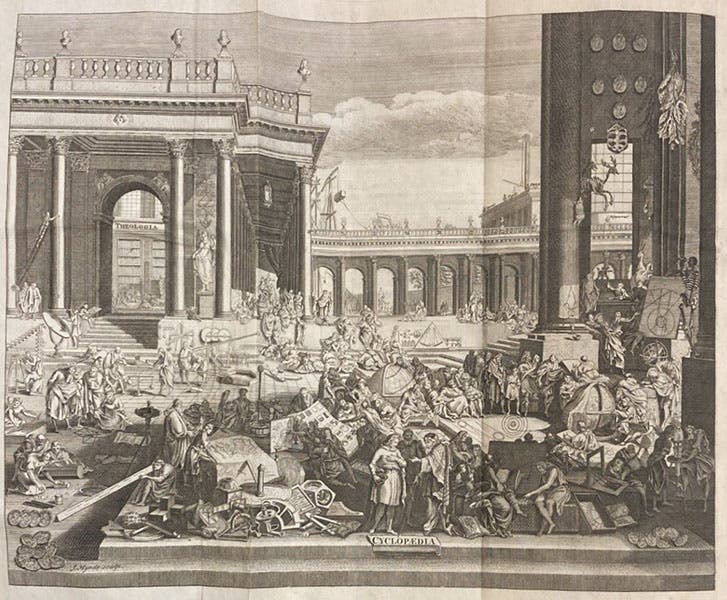
Engraved frontispiece, Cyclopædia, or, an Universal Dictionary of Arts and Sciences, by Ephraim Chambers, 7th ed., vol. 1, 1751-52 (Linda Hall Library)
Chambers feverishly compiled entries for decades and attracted subscribers, and in 1728, he published his two-volume Cyclopædia, or, an Universal Dictionary of Arts and Sciences. These were huge folio volumes, crammed with information on both the arts and the sciences. The set sold well and went through many editions. Our copy was published in 1751-52, and that is a seventh edition. The first edition was the world's first encyclopedia.

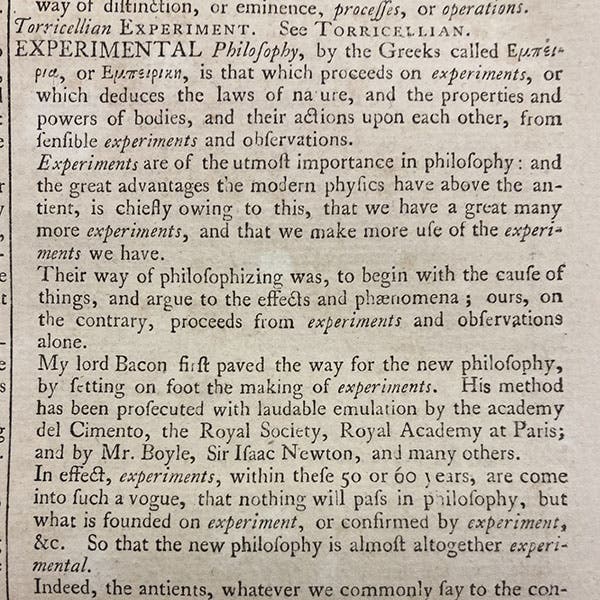
Beginning of entry on “Experimental Philosophy,” Cyclopædia, or, an Universal Dictionary of Arts and Sciences, by Ephraim Chambers, 7th ed., vol. 1, 1751-52 (Linda Hall Library)
The volumes are arranged by subject matter in alphabetical order, with each page headed with the first three letters of the subject under discussion, such as EXP for experiment, or HYD for hydraulics. There are no page numbers.

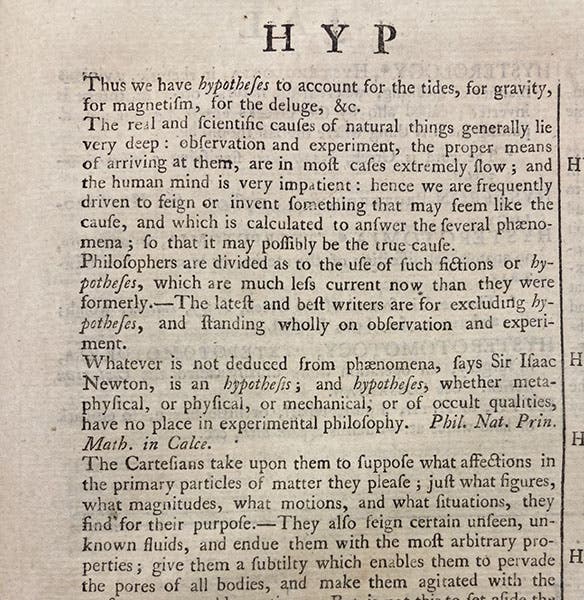
Detail of entry on “Hypothesis,” Cyclopædia, or, an Universal Dictionary of Arts and Sciences, by Ephraim Chambers, 7th ed., vol. 1, 1751-52 (Linda Hall Library)
Chambers's Cyclopædia has occasional full-page plates, of which we show one for “Hydraulics” (first image), and a busy fold-out frontispiece (third image), but one would not exactly call this an illustrated encyclopedia. The text is of much more interest, revealing that Chambers was quite up to date on the "new science" of Francis Bacon, Robert Boyle, and especially Isaac Newton, as you can see in the extracts we include on “Experimental philosophy” and “Hypothesis” (fourth and fifth images). Like a good Englishman, Chambers did not think much of René Descartes or the Cartesians.

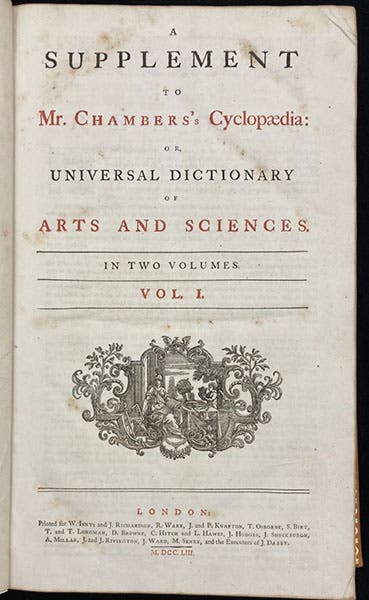
Title page, A Supplement to Mr. Chambers's Cyclopaedia: or, Universal Dictionary of Arts and Sciences, ed. by John Hill et al., vol. 1, 1753 (Linda Hall Library)
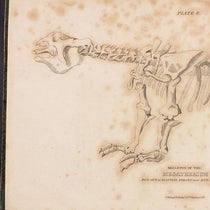
The fact that we have only a seventh edition of the Cyclopædia is compensated for by the fact that a Supplement, also in two volumes, was issued in 1753, compiled from entries written by Chambers before his death in 1740, and we have the first edition of the Supplement, bound to match the first two volumes of the Cyclopædia (sixth image). The four volumes together make a handsome set. The Supplement was edited by, among others, John Hill, who was responsible for adding a handful of large engraved plates crammed with animals and plants, of which we show one (last image).

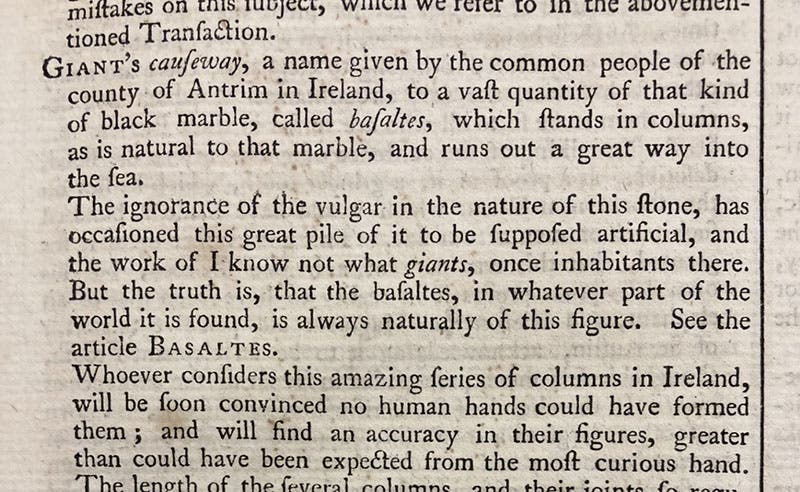
Beginning of entry on “Giant’s Causeway,” A Supplement to Mr. Chambers's Cyclopaedia: or, Universal Dictionary of Arts and Sciences, ed. by John Hill et al., vol. 1, 1753 (Linda Hall Library)

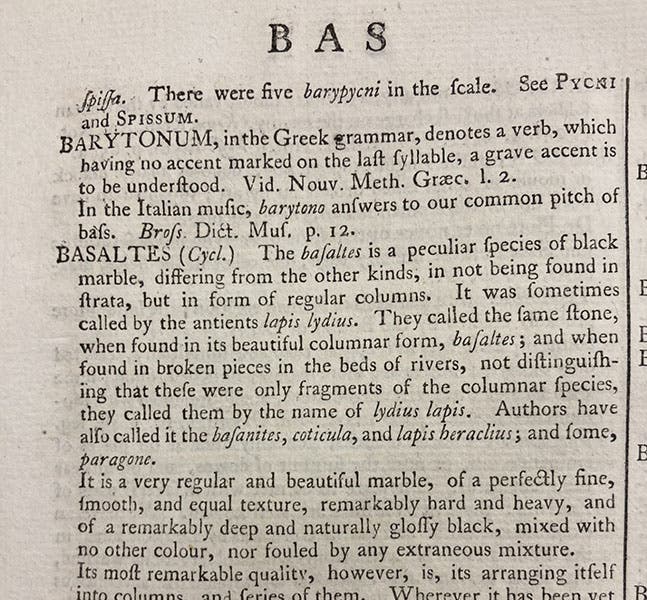
Beginning of entry on “Basaltes,” A Supplement to Mr. Chambers's Cyclopaedia: or, Universal Dictionary of Arts and Sciences, ed. by John Hill et al., vol. 1, 1753 (Linda Hall Library)
We chose two entries from the Supplement to demonstrate what most experts consider to be the most significant innovation of Chambers' Cyclopædia – the use of cross-references. In his entry on the “Giant’s causeway” in Ireland, Chambers mentioned that it is formed from basalt, and then added: see BASALTES (seventh image). Sure enough, there is an entry on “Basaltes,” where we can learn more about this kind of rock (eighth image). Nearly every entry has at least one cross reference, and Chambers seems to have invented the practice – there are no cross-references in Harris' Lexicon. So not only did Chambers invent the encyclopedia, he introduced its most crucial and distinctive element.

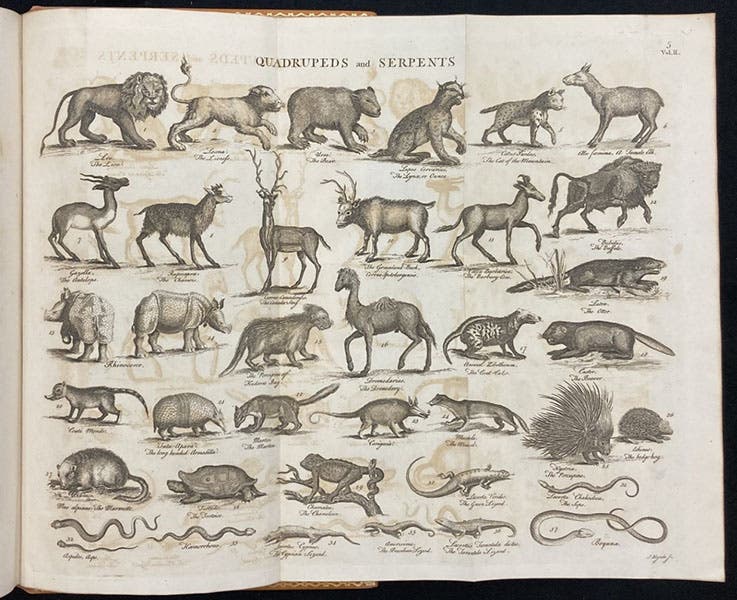
“Quadrupeds and Serpents,” engraving,” A Supplement to Mr. Chambers's Cyclopaedia: or, Universal Dictionary of Arts and Sciences, ed. by John Hill et al., vol. 1, plate 5 at end, 1753 (Linda Hall Library)
There seems little doubt that Chambers' Cyclopædia inspired the creation of the French Encyclopedie (1751-72) of Denis Diderot, and the first edition of the Encyclopedia Britannica (1769-71). Chambers was honored by being invited to fellowship in the Royal Society of London in 1729, immediately after his Cyclopædia was published, and he was buried in the cloisters of Westminster Abbey. If he ever had his portrait painted, it has not survived.
William B. Ashworth, Jr., Consultant for the History of Science, Linda Hall Library and Associate Professor emeritus, Department of History, University of Missouri-Kansas City. Comments or corrections are welcome; please direct to ashworthw@umkc.edu.