Scientist of the Day - Maria Merian

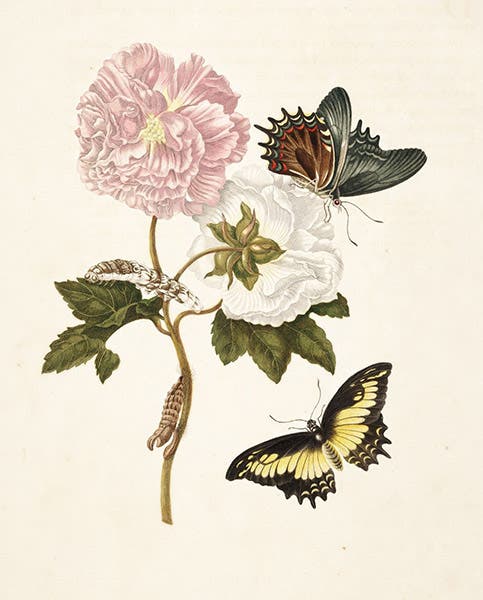
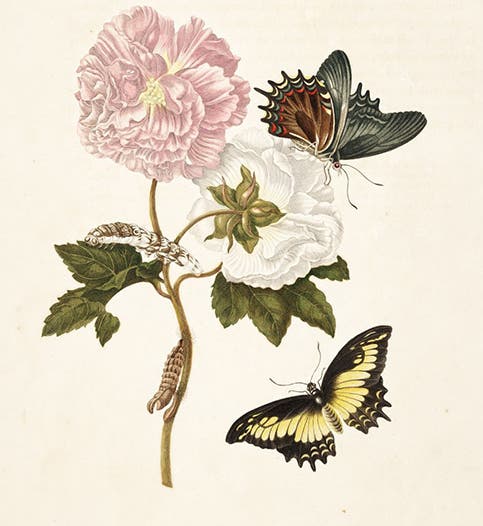
Heraclides butterfly on a hibiscus, hand-colored engraving in Metamorphosis insectorum surinamensium, by Maria Merian, plate 31, slightly cropped, 1705 (Linda Hall Library)
Maria Merian, a German/Dutch artist and naturalist, died Jan. 13, 1716, at age 69. Merian was the first great woman scientist of the early modern era. What she accomplished with no help from anyone is truly remarkable.

Portrait of Maria Merian, oil on canvas, by Jacob Marrel , 1679, Kunstmuseum, Basel (Wikimedia commons)
Maria was the daughter of the artist Matthäus Merian of Frankfurt, but he died when she was just three. Her stepfather, also a painter, recognized her artistic talent and tutored her. Maria’s interest in insects and metamorphosis developed at an early age. She married and would have two daughters, Johanna and Dorothea, 10 years apart, beginning in 1668, whom she taught to paint. Her marriage eventually ended in divorce. She supported herself and her daughters by selling paintings and by teaching, while living in Nuremberg, Frankfurt, and Amsterdam. In Amsterdam, Maria gained a substantial enough reputation to be granted access to the natural history collections of Nicolaes Witsen, the mayor, and Frederik Ruysch, which must have kindled in her a desire to see exotic insects and flowers in their natural setting. She also taught the art of painting to Rachel Ruysch, Frederik’s daughter, whom we have featured in a separate post.

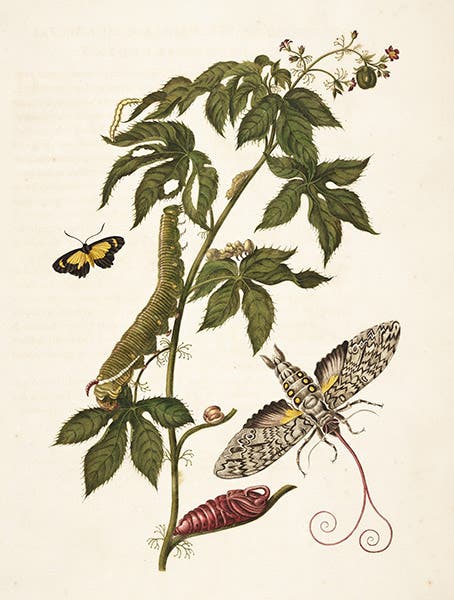
Cyllopoda moth on a belly ache bush, hand-colored engraving in Metamorphosis insectorum surinamensium, by Maria Merian, plate 38, slightly cropped, 1705 (Linda Hall Library)
In 1699, Maria, 52 years old, and her younger daughter travelled to Suriname, or Dutch Guiana, on the northeast coast of South America, in order to draw insects, especially butterflies and moths, and the various stages of their metamorphoses. As far as we can tell, she did not have a patron and paid for the trip herself. She planned to stay for 5 years, but after two, she got sick, probably with malaria, and came home. Over the next three years, she and her daughters finished 60 paintings of flowers and insects, and they engraved their paintings on copper plates. These were printed, hand-colored, and published as Metamorphosis insectorum surinamensium in 1705. We have the set in our collections.

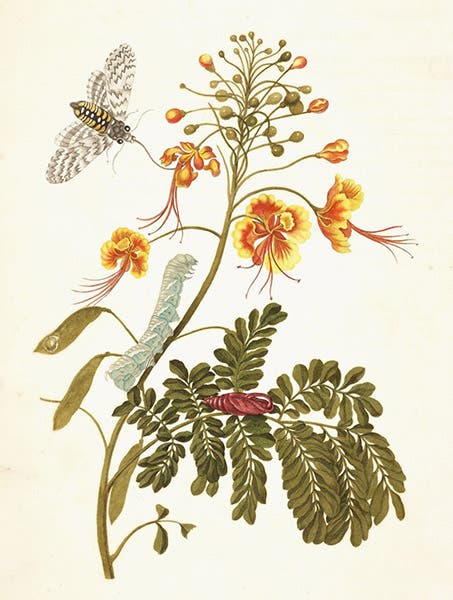
Tobacco hornworm and moth on a peacock flower, hand-colored engraving in Metamorphosis insectorum surinamensium, by Maria Merian, plate 45, slightly cropped, 1705 (Linda Hall Library)
The Metamorphosis is a great pleasure to leaf through, which you can do yourself at this link to our scanned copy. It appears at first to be a tropical Flora, but you quickly realize that insects, mostly butterflies and moths, are the real subject, and they are shown in all stages of development: chrysalis, caterpillar, and adult.

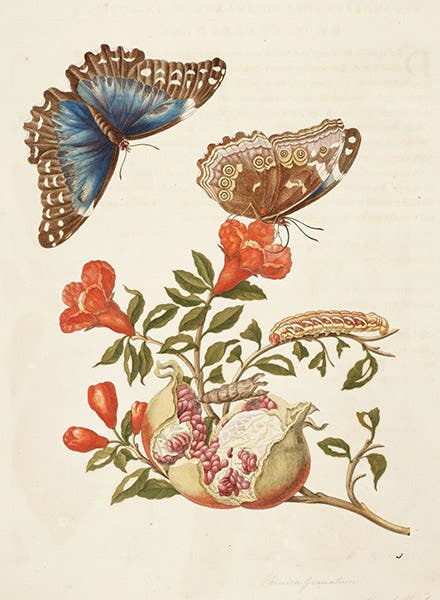
Morpho butterfly on a pomegranate, hand-colored engraving in Metamorphosis insectorum surinamensium, by Maria Merian, plate 9, slightly cropped, 1705 (Linda Hall Library)
You will also notice that the plates are beautifully composed, with flowers, leaves, insects, fruit, and sometimes amphibians and spiders, counterpoised in a harmonious manner, demonstrating that Merian was an artist in every sense of the word.

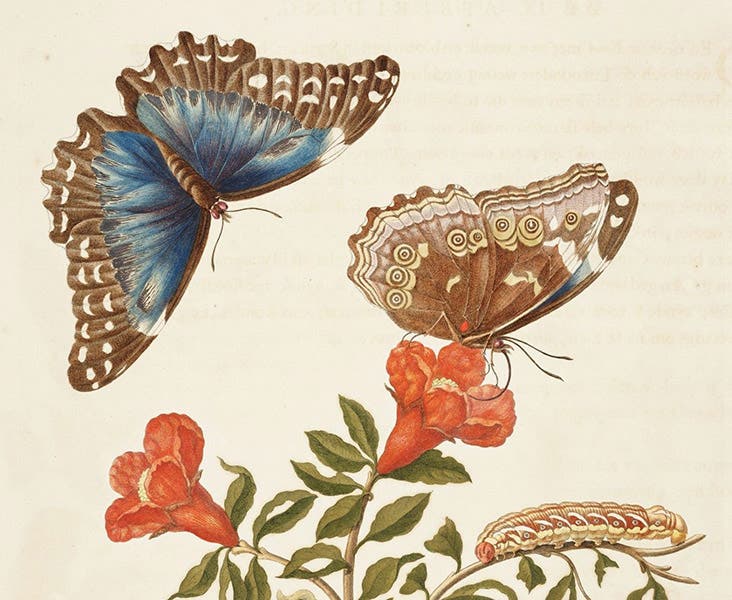
Detail of image above, Metamorphosis insectorum surinamensium, by Maria Merian, plate 9, 1705 (Linda Hall Library)
We wrote a brief post on Merian in 2015, back when we were just getting started, and we showed there 5 plates from her book, plus the title page. Here we show 5 more plates, this time cropping the plates slightly to enlarge the images, and also providing two additional details, so you can appreciate Maria's artwork. It is assumed that her daughters had some role, perhaps a considerable one, in the execution of the 60 paintings and engravings, but how much is difficult to determine. As it was published under her name, we give Maria the bulk of the credit.

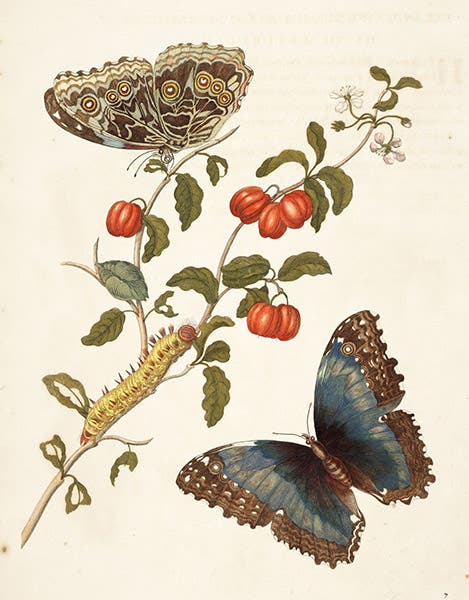
Morpho butterfly on a Barbados cherry tree, hand-colored engraving in Metamorphosis insectorum surinamensium, by Maria Merian, plate 7, slightly cropped, 1705 (Linda Hall Library)
We acquired our copy of the Metamorphoses in an unusual fashion. In 1979, when Bruce Bradley and I were both relatively new to the Library, a farmer from central Missouri brought in a book for evaluation, a book that had been in the family for generations. Lo and behold, it was not a Bible, but Merian's book. We had never seen a copy before, but we looked up the auction and sale records and told him the book was rare and worth about $15,000. He was more than a little surprised, thanked us, and left with the book. A few days later, he was back, with the book, and he said he hadn't been able to sleep, knowing that such a valuable object was just sitting there in his farmhouse, so he had decided to give it to us, in exchange for an evaluation for tax purposes. We were happy to comply with his intentions. The binding was falling apart, so we had a restoration expert take it apart and store the 60 plates and their accompanying sheets of descriptive text in a specially made box, where the plates still reside.

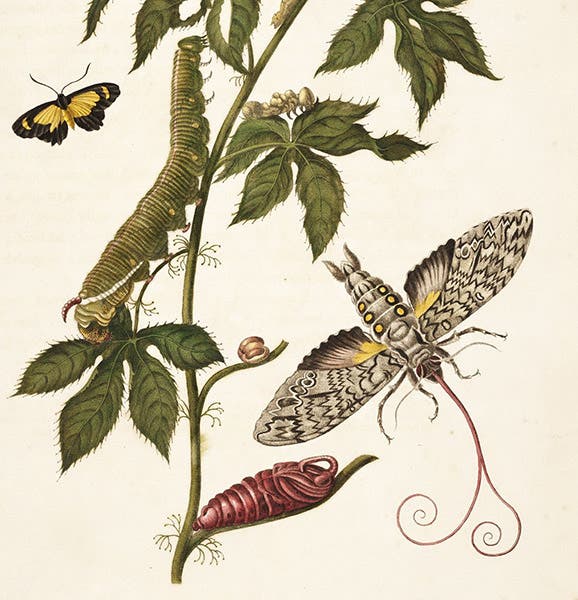
Detail of third image, Cyllopoda moth and chrysalis, Metamorphosis insectorum surinamensium, by Maria Merian, plate 38, 1705 (Linda Hall Library)
Maria Merian was pretty much ignored until the last half of the 19th century, but she is now a popular example of a woman who achieved success in a scientific field at a time when women were discouraged from doing so. Her Metamorphosis has been published several times in facsimile, with the Dutch text (and her introduction) translated into various languages, including English. We have most of those here in our library, and they may well be available in a library near you.
William B. Ashworth, Jr., Consultant for the History of Science, Linda Hall Library and Associate Professor emeritus, Department of History, University of Missouri-Kansas City. Comments or corrections are welcome; please direct to ashworthw@umkc.edu.