Scientist of the Day - Robert Mylne

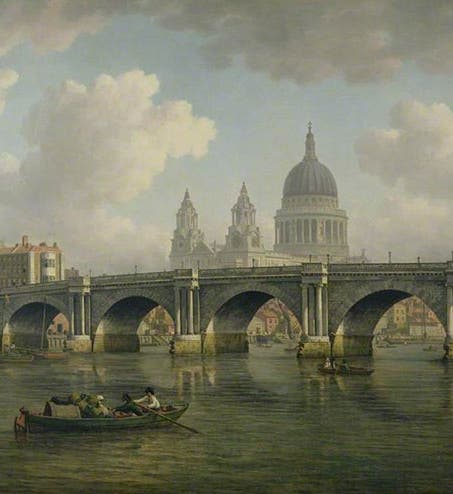
Blackfriars Bridge, with St. Paul’s Cathedral in the background, oil on canvas, by William Marlow, ca 1770, Guildhall Art Gallery (Wikimedia commons)
Robert Mylne, a Scottish architect/civil engineer, died May 5, 1811, at age 78. From a century that gave us highly reputed builders, such as John Smeaton, Robert Adam, and James Wyatt, and a young Thomas Telford, Mylne is hardly ever mentioned. He is widely recognized for the design of the first Blackfriars Bridge over the Thames, which we will get to. But he did dozens of other public buildings, bridges, canals, and estate houses for which he is seldom recognized.

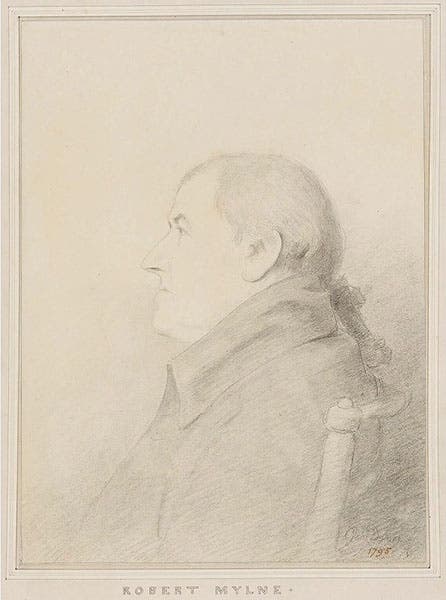
Portrait of Robert Mylne, pencil on paper, by George Dance, 1795, National Portrait Gallery, London (npg.org.uk)
Mylne was the son of a surveyor and mason (and the great grandson of the builder of Holyrood Castle in Edinburgh), and he went to Italy in 1754 to study architecture, where he had the good fortune to acquire the tutelage of Giovanni Battista Piranesi. He entered a competition in Rome, at the Academy of Saint Luke, to design a public space, which he surprisingly won.

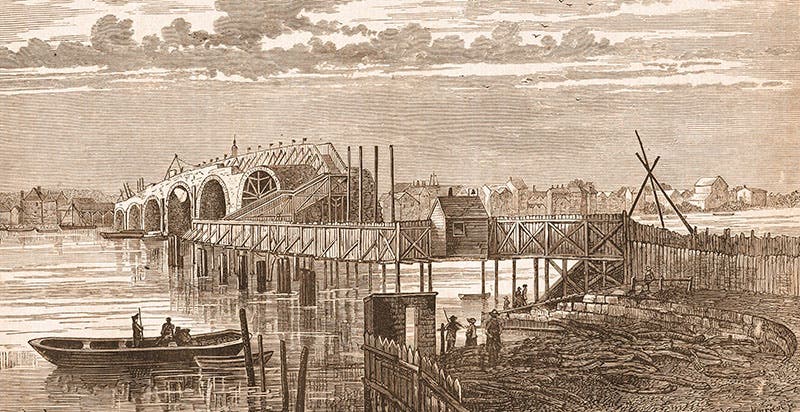
The old Blackfriars Bridge under construction, 1760s, engraving, with wooden walkways providing pedestrian access while construction was underway (thehistoryoflondon.co.uk)
After five years abroad, he finally returned to Great Britain in 1759, where architects and engineers were busy submitting designs for a new bridge in London, between London Bridge and Westminster Bridge, the only other spans across the Thames in central London. Mylne, then 26 years old, entered the competition, vying with the likes of Smeaton, and amazingly, his design for a bridge with 9 elliptical arches was selected by the committee. He spent 9 years on the project, having to contend with the powerful watermen's lobbies, which strongly resisted building another bridge to rob them of passengers. Mylne constructed his bridge of Portland stone, which Christopher Wren had used for the new St. Paul's cathedral. When completed in 1769, Blackfriars Bridge, named for a nearby Dominican abbey, was a good-looking span, and it sat happily for portraits by notable English artists, such as William Harlow (first image).
As it turned out, Portland stone may not have been the best choice for a bridge that had to withstand the currents and eddies caused by the constricting London Bridge, because a century later, the old Blackfriars Bridge had to be replaced with the span that still stands. This is probably one reason why Mylne is not better known – his principal monument is gone.
But in 1769, when his Blackfriars Bridge was opened to the public, Mylne was a major architectural figure. His bridge was widely admired for its graceful lines and handsome arches. He and Smeaton founded the Society of Civil Engineers in 1771. Mylne was appointed surveyor for St. Paul's, responsible for maintaining Wren's legacy. He designed all sorts of buildings, both in London and back in Scotland. He was chief surveyor for the New River Company, which supplied water to London. When the anatomist William Hunter wanted a new house in Great Windmill Street, with a medical school next door, he asked Mylne to design both; the house still stands, having been incorporated into the rear elevation of the Lyric Theatre when it was built in London's West End in 1888.

Hexham Bridge, Northumberland, designed and built by Robert Mylne, 1793, modem photo (Wikimedia commons)
One standing testament to Mylne’s skill as an engineer is Hexham Bridge over the River Tyne in Northumberland. Three bridges had been built there between 1770 and 1782, and each one was toppled by storms or floods. The third was built by none other than Smeaton; his bridge was finished in 1780, and two years later, all nine arches had been scattered by a fierce spring storm. Mylne was given the contract for the fourth Hexham Bridge, which was finished in 1793. It still stands, 233 years later (fourth image).


“Men of Science Living in 1807-8”, engraving by William Walker, Jr., and George Zobel, 1862, National Portrait Gallery, London; Robert Mylne is at the right, standing in a dark coat, facing left, just behind a bulky John Rennie (npg.org.uk)
There is only one portrait of Mylne in England, a pencil sketch of 1795, in the National Portrait Gallery (NPG) in London (second image). It was the basis for Mylne’s inclusion in the engraving, “Men of Science Living in 1807-8”, by William Walker, Jr. and George Zobel, 1862, that we have often invoked in this series. Mylne is standing at the right, facing left, easily picked out because of his dark coat; he stands right behind another noted engineer, John Rennie (fifth image). Click on the image for a zoomable link. You can see a preliminary drawing for the engraving, also at the NPG, at this link.
William B. Ashworth, Jr., Consultant for the History of Science, Linda Hall Library and Associate Professor emeritus, Department of History, University of Missouri-Kansas City. Comments or corrections are welcome; please direct to ashworthw@umkc.edu.