Scientist of the Day - Richard of Wallingford

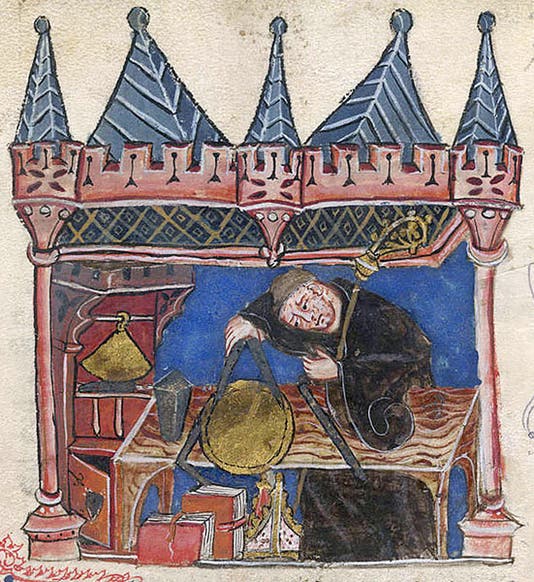
Richard of Wallingford, Abbot of St. Albans, constructing an astronomical instrument, illumination, MS Cotton Claud. E. iv, fol. 201r, 14th-century, British Museum (Wikimedia commons)
Richard of Wallingford, an English abbot and astronomer, was born in Wallingford England, around 1292, and died at St. Albans in 1336, at the age of 44 or so. Wallingford is due west of London and just south of Oxford. Richard's father was a blacksmith; when he died when Richard was a boy, he was taken into the charge of a Benedictine prior in Wallingford who had ties to the great Abbey at St. Albans, north of London. Richard attended Oxford, where he studied astronomy as well as theology. He became a monk at St. Albans, returned to Oxford for nine more years, and then went back to St. Albans. When the Abott died in 1327, Richard, the best educated of the monks, was chosen to be the next Abbot.

St. Albans Cathedral, recent photo by David Iliff (Wikimedia commons)
Richard ruled the Abbey, the most prestigious in England, with an iron hand, trying to restore the Benedictine rule, which had been ignored for some time, and ensuring that the Abbot's office received the tithes that were due, so that he could proceed with badly needed repairs and rebuilding. He also needed money to build his clock, which brings us to the crux of our discussion.

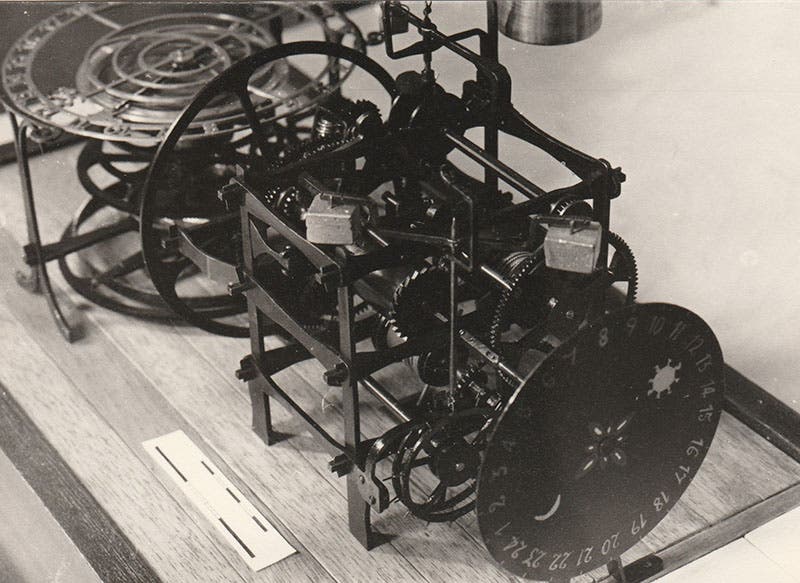
Replica of clock of St. Albans Abbey designed by Richard of Wallingford, original built ca 1356, replica by Peter and lan Howard, 1980s?, now in Halim Museum, Evanston, Illinois (Wikimedia commons)
Mechanical clocks were new in the 14th century, if we mean clocks that struck the hours. Some think they came out of Italy (see our post on Giovanni de Dondi), some see England as the birthplace. The latter group points to Richard as evidence, for he designed the most sophisticated mechanical clock to date around 1328-30. It not only told the time and struck the hours, it tracked the Moon and Sun and the other 5 planets, displayed the phase of the Moon and even eclipsed it at the appropriate times, and, as a bonus, showed the time of afternoon high tide at London Bridge. Richard died before the clock could be built, but it was constructed according to Richard's written directions and placed in the south transept in St. Albans in 1356, where John Leland marveled at it 200 years later, just before Henry VIII dissolved the English monasteries, looted St. Albans, and destroyed the clock.

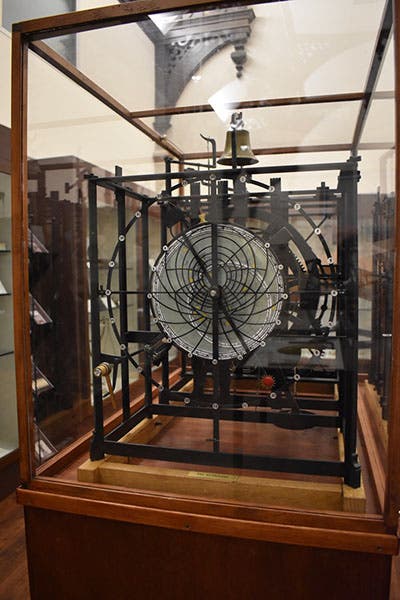
Replica of Richard of Wallingford’s astronomical clock, St. Albans Cathedral, builder unknown (stalbansmuseums.org.uk)
Fortunately, Richard's directions for building his astronomical clock survived, although no one knew that they had, or where they were, until a young historian of medieval astronomy, John North, leafed through Ashmole MS 1796 at the Bodleian Library at Oxford and found that, scattered through the 200 parchment leaves of the bound volume, was the Treatise on Clockmaking of Richard of Wallingford, out of order but near-complete, and including diagrams of mechanisms and tables that would be needed to build such a clock. North re-organized and published the text in 1976, with translation and commentary, and since then, at least three working replicas of Richard's clock have been built. The first was constructed for the Time Museum in Rockford, Illinois. When that museum closed its doors, the clock was transferred to the Halim Time and Glass Museum in Evanston, Illinois, where it may still be seen, as far as I know (third image). I need to make that trip.

One-quarter-size replica of clock of St. Albans Abbey designed by Richard of Wallingford, original built ca 1356, replica by Don Unwin, 1992, Whipple Museum, Cambridge (collections.whipplemuseum.cam.ac.uk)
There is another full-sized replica in St. Albans itself, now St. Albans Cathedral, in one of the side aisles (fourth image). And there is a third, this one a one-quarter scale working model, in the Whipple Museum at the University of Cambridge (fifth image). You can see that one in operation in this video.

Richard of Wallingford, Abbot of St. Albans, pointing to his clock in the south transept, with marks of leprosy on his face, illumination, MS Cotton Nero D.7, fol. 20r, 14h-century, British Museum (Wikimedia commons)
Richard was no doubt distracted from building his clock by the fact that he contracted leprosy around 1528 and ultimately died of his affliction, as lepers usually did. The second of the two illuminated miniatures that provide us with a portrayal of Richard, shows us a face ravaged by the disease (sixth image). It was a hard way to go, especially for a man with a marvelous clock to give to the world.
Richard of Wallingford does not get nearly enough credit for his achievement in designing a working astronomical clock in 1330. All of the gearing, and the crucial escapement that regulated everything, had to be designed from scratch, because, except for water clocks, there was no precedent. Plus, Richard had to have total mastery of Ptolemaic astronomical theory, in other to couple the movements of the planets to a 24-hour day. His treatise was a tour-de-force, and so was the constructed clock, although Richard did not live to see it. It is a damn shame that Henry VIII destroyed it, for otherwise, the original might still be striking the hours and eclipsing the Moon, 670 years after it was first set in motion. Then the Prague Astronomical Clock (1410), which is considerably less sophisticated than the St. Albans Clock, would be the second oldest operating mechanical clock in the world.
Almost 30 years after his 3-volume magnum opus on Richard and his clock appeared, John North published a one volume-book intended for the non-specialist. It is still a mouthful, but it is fascinating reading, should you want to learn more about the life of a 14th-century abbot. The book is called God's Clockmaker: Richard of Wallingford and the Invention of Time (2005). I highly recommend it.
William B. Ashworth, Jr., Consultant for the History of Science, Linda Hall Library and Associate Professor emeritus, Department of History, University of Missouri-Kansas City. Comments or corrections are welcome; please direct to ashworthw@umkc.edu.