Scientist of the Day - Adrien Barrère

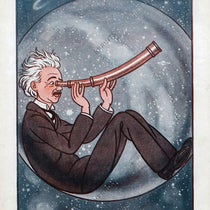
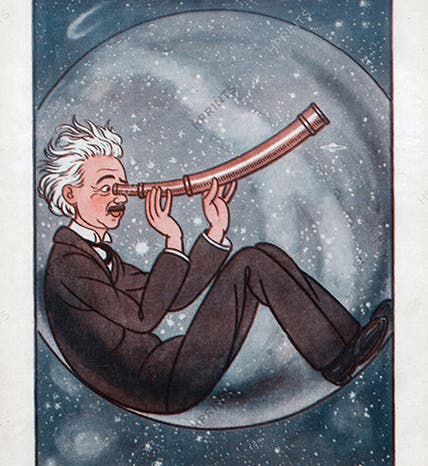
Caricature of Albert Einstein, color lithograph, by Adrien Barrère, 1930 (Wikimedia commons)
Adrien Barrère, the pen name of Adrien Baneux, a French artist and caricaturist, was born on Nov. 13, 1874, in Paris. He attended medical school and law school, which accounts for the subject matter of his most famous caricatures, but he spent most of his career from 1900 to 1931 drawing theatrical posters for the Pathé brothers, hundreds of which you can find on Wikimedia commons at this link, and elsewhere. Only one of these is at all scientific, a delightful sketch of Albert Einstein, whose telescope has suffered from the curvature of space-time. We show it as our first image, so as not to spoil the surprise of Barrère’s medical caricatures.

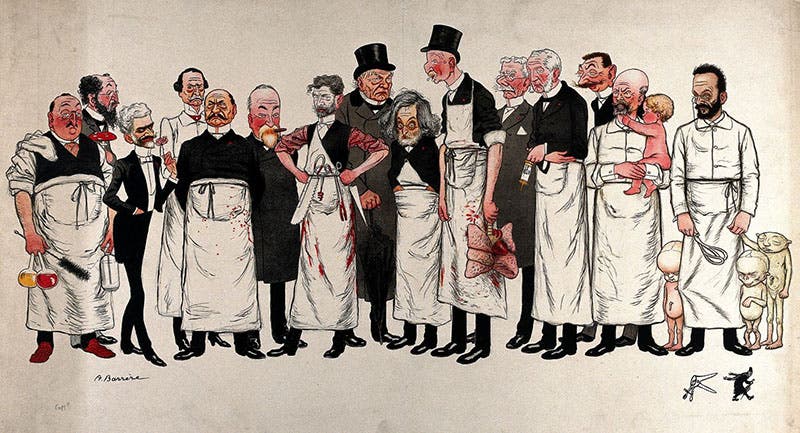
“Fifteen French doctors wearing aprons and holding various instruments,” color lithograph by Adrien Barrère, 1903, Wellcome Collection, London (wellcomecollection.org)
Barrère did four group portrait caricatures of the faculty of the Paris Medical School. The first of these, in 1903, is the most famous, and it should be, as it is his finest work (second image). It depicts 15 doctors and surgeons, each holding an attribute of his medical specialty. Each of the 15 is known by name, and most have Wikipedia articles of their own. Most sites that display the poster, such as the Wellcome Collection, Wikipedia, and the Paris School of Medicine, identify all 15 of the subjects and explain the attributes.

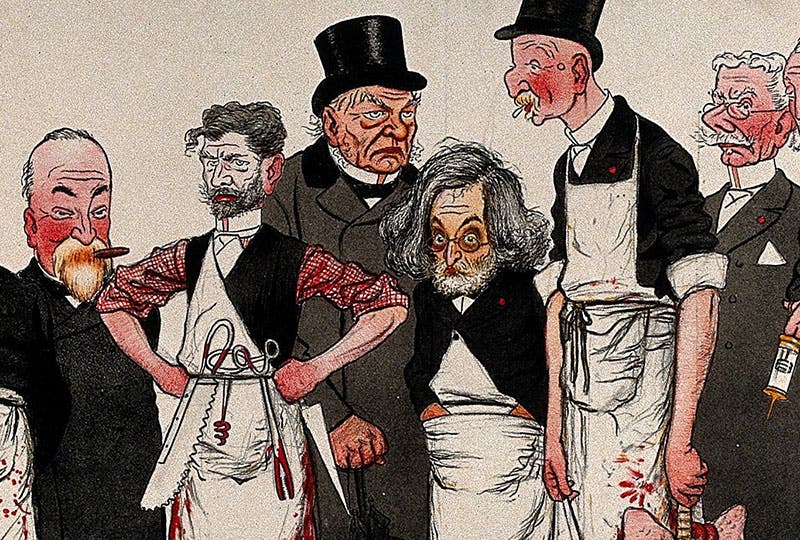
Detail of second image, with Samuel Pozzi, second from left, and Georges Hayem, fourth from left, “Fifteen French doctors …,” color lithograph by Adrien Barrère, 1903, Wellcome Collection, London (wellcomecollection.org)
The first time I saw this poster, which was not that long ago, I recognized only one of the subjects, Samuel-Jean Pozzi, a socialite gynecologist who was the subject of a famous portrait-in-red by John Singer Sergeant (now in the Hammer Museum in LA), which you can see in our post on Pozzi. In the poster, he is seventh from the left, with a corkscrew and forceps on his belt; in the detail, he is second from the left.
An essential skill of a good caricaturist is that he be able to exaggerate a face and figure in clever ways while keeping the subject recognizable. So that you appreciate Barrere's facility at doing that, I include a portrait of Georges Hayem (fourth image), a pioneer hematologist, who is the short individual, fourth from the left right in our detail (third image).

Portrait of Geoges Hayem, 1896, one of Barrère’s subjects in his 1903 lithograph (second and third images) (Wikimedia commons)
You can see three more group portraits (1906-1910) of the Paris Medical Faculty in the Wellcome Collection in London, at this link. One of them shows each physician in a test tube, and another in specimen jars, but none are as captivating as the first.
These posters, by the way, were lithographed in color and distributed to medical students; they were printed by the tens of thousands, and can be found in many odd places, including eBay and auction houses, although sets of four are not so common.
The main reason I show Barrère's handiwork is to lament an opportunity lost – if only Barrère had studied physics instead of medicine.

Group portrait of the participants at the 5th Solvay Conference in Brussels, 1927 (Wikimedia commons)
The most famous group portrait in physics was taken at the Solvay Conference in Brussels in 1927 (fifth image). It shows Albert Einstein, Marie Curie, and Max Planck in the front row, and those upstart quantum physicists, Werner Heisenberg, Wolfgang Pauli, and Erwin Schrödinger at right rear. Can you imagine what we would have if Adrien Barrère were there in 1927 and allowed to do his thing? We would have the most exciting caricature in the history of the world. I shake my head in sorrow at the loss.
Surprisingly, Barrère never turned his pen on himself. There is one photograph claiming to be his portrait online, but it is doubtful, and there is no caricature. Perhaps he used himself as a participant in some of his posters of the Folies Bergère, but it is hard to know. It would be nice to have a face, a Machiavellian face, to go with his name and posters.
William B. Ashworth, Jr., Consultant for the History of Science, Linda Hall Library and Associate Professor emeritus, Department of History, University of Missouri-Kansas City. Comments or corrections are welcome; please direct to ashworthw@umkc.edu.