Scientist of the Day - Alois Senefelder

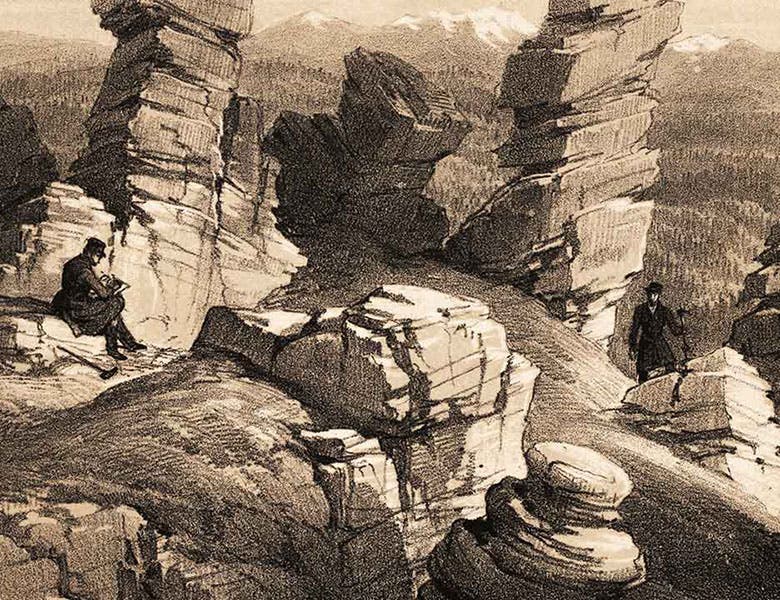
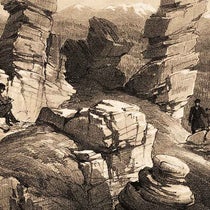
“View from the summit of the Katchkanar,” drawn by Roderick Murchison and lithographed by Louis Haghe, in Murchison et al., The Geology of Russia, 1845 (The Linda Hall)
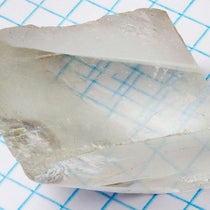
Alois Senefelder, a German playwright and actor, was born Nov. 6, 1771, in Prague. I don't know if any of his plays are still performed, but sometime before 1796, he achieved immortality of a different sort by inventing a new printing process, called lithography, which means "stone printing." A lithographic stone is a slab of fine-grained limestone that has been polished and then used as a drawing surface. If you draw on the stone with a greasy stylus, and then moisten the stone and apply printer’s ink, the ink will stick only to the grease pattern, and what you have drawn will print. The texture of a lithograph is quite distinct and much softer than an engraving. It is suitable for landscapes and portraits, and ideal for geology illustrations and fossils. It does require a new kind of printing press, but that was no great technological obstacle, and by 1820, lithographs began to appear in scientific books and journals with increasing frequency.

Statue of Alois Senefelder, pulling a print from a lithographic stone, Solnhofen, Bavaria, Germany (Wikimedia commons)
We wrote our first post on Senefelder on this day in 2018, which included 6 examples of lithographs from works of science in the period from 1820 to 1863. We had publicly displayed 50 such lithographs in an exhibition in 2013, called Crayon and Stone: Science Embraces the Lithograph, 1800-1899, which was just glorious, in my opinion, and to which we would ordinarily refer you. However, the administration in place at the time did not allow us to print a catalog or even put one up online, so that exhibition is gone forever. Today, therefore, we show six more lithographs that we displayed in 2013, ones that are special favorites of mine. We stick today to the first 40 years of lithographic book illustration. Lithography changed with the introduction in the last half of the 19th century of chromolithography – printing in color from multiple stones. We will write a separate post some day on our favorite chromolithographs.

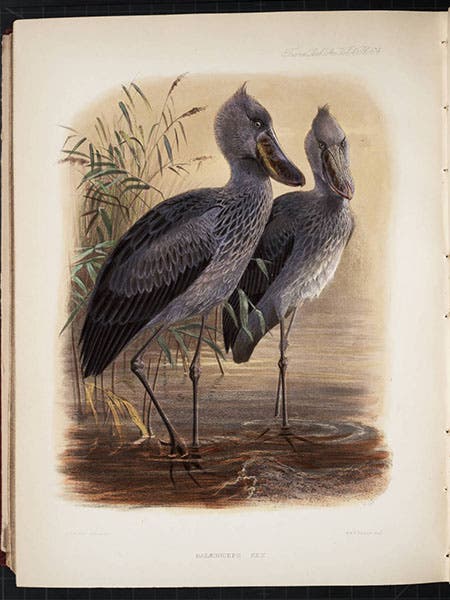
Shoebills of Africa, hand-colored lithograph by Joseph Wolf, Transactions of the Zoological Society of London, vol. 4, 1862 (The Linda Hall)
For each of the following, we identify the author of the book or article, but say little more about him, because each is the subject of an earlier post, and if you select any of those links, you can see many more example of lithographs in the cause of science.
We begin with my favorite lithograph from the exhibition, showing a pair of shoebills, large wading scavengers from Africa that were drawn on stone by Joseph Wolf, for an article by William K. Parker in the Transactions of the Zoological Society of London (third image). We used these two lovely but unloveable birds for our exhibition poster.

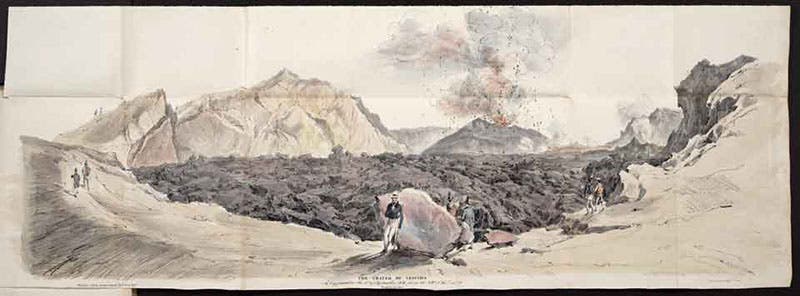
Panoramic view of the Vesuvius crater, Sept. 18, 1831, with Auldjo in the center, and others of his party wandering about, folding hand-colored lithograph, from John Auldjo, Sketches of Vesuvius, 1832 (The Linda Hall)
My second-favorite set of lithographs appeared in a book on an erupting Mount Vesuvius by a visiting Englishman, John Auldjo. Some of these lithographs are foldouts; we show one of those; there are many more at the link. Auldjo did all of the drawings for the prints; I do not know if he drew them on stone.
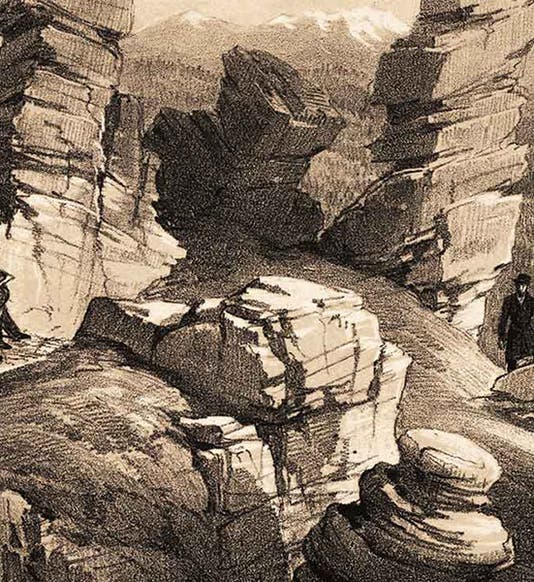
Our third selection (first image) is from Roderick Murchison's geological tour of Russia (1845). His travelling companion was the Russian geologist Alexander von Keyserling, and his artist was Louis Haghe. You will find lovely lithos at both links, all different: we chose here a detail from a landscape that demonstrates how well a lithograph captures the texture of rock.

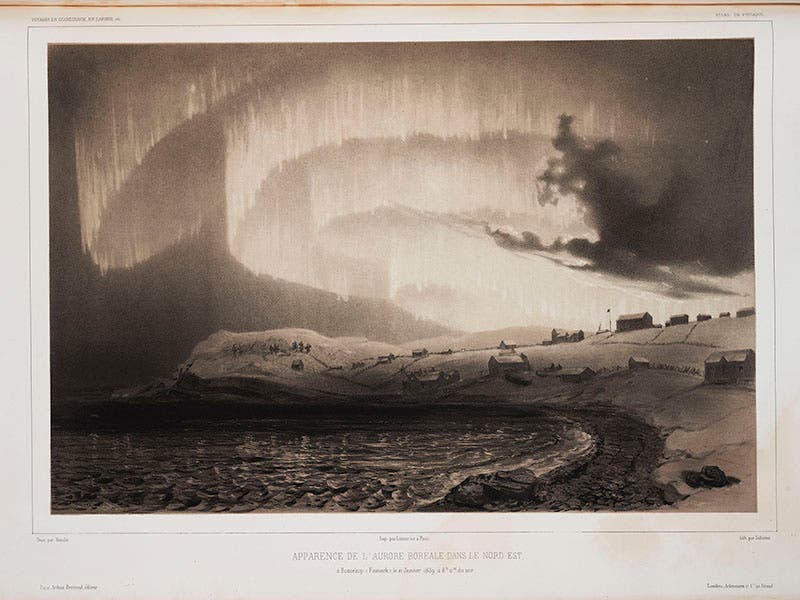
Aurora observed at Bossekop, Finnmark, Jan. 21, 1839, tinted lithograph from Joseph-Paul Gaimard, Voyages … en Scandinavie, en Laponie, au Spitzberg et aux Feröe, 1840-55 Atlas geologique (The Linda Hall)
Our fourth selection comes from a French zoologist and explorer, Joseph-Paul Gaimard, who travelled to Spitsbergen up above the Arctic Circle in 1838-40, and recorded his impressions in lithographs, one of them showing a formidable sky-full of northern lights (fifth image).
Our final selection is a fossil fish from a book by Louis Agassiz on fossil fish, published in 1833, when he was still young, although by the time he finished it, he was 10 years older (last image). Drawing an impression of a piece of stone on another piece of stone was such a brilliant idea!

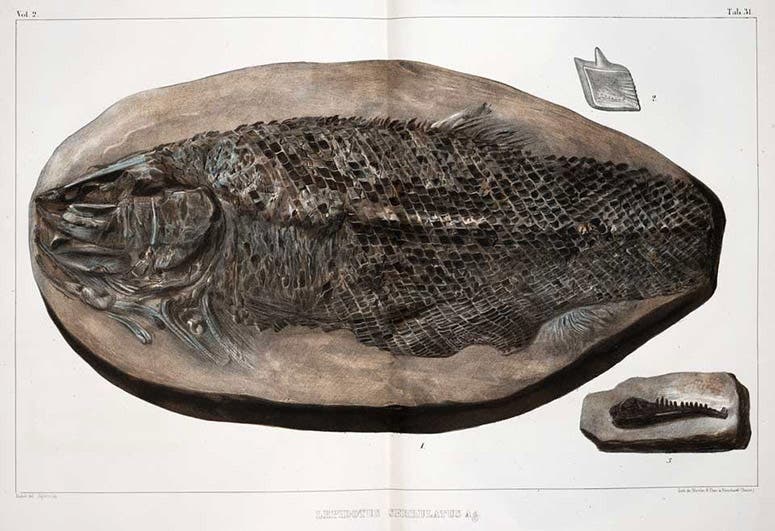
Lepidotus, a fossil fish, the entire plate, hand-colored lithograph, Recherches sur les poissons fossils: Atlas, by Louis Agassiz, plate 31, vol. 2, 1833-43 (The Linda Hall)
The world's finest lithographic limestone comes from Solnhofen in Bavarian Germany. So it is not surprising that the town commissioned a statue of Senefelder (second image). It shows him pulling a print from a lithographic stone. A replica would make a good bookend, paired with one modeled after the other Senefelder statue in Berlin, which we showed in our first post on Senefelder.
Senefelder was buried in the Alter Südfriedhof in Munich, sharing the grounds with telescope maker Joseph Fraunhofer and the chemist Justus Liebig.
William B. Ashworth, Jr., Consultant for the History of Science, Linda Hall Library and Associate Professor emeritus, Department of History, University of Missouri-Kansas City. Comments or corrections are welcome; please direct to ashworthw@umkc.edu.