

Scientist of the Day - Jan van Eyck

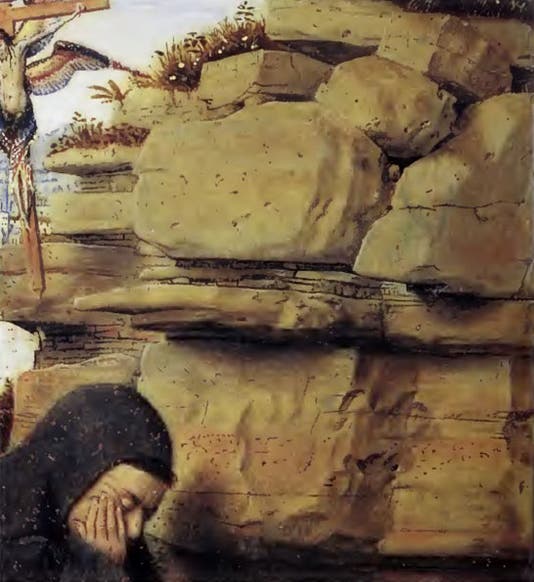
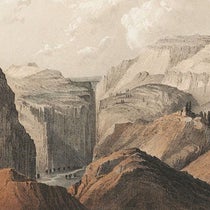
Detail of limestone formation, Saint Francis of Assisi Receiving the Stigmata, by Jan van Eyck, ca 1430, Philadelphia Museum of Art (Wikimedia commons)
Jan van Eyck, an early Netherlandish painter, died July 9, 1441, at the age of either 51 or 61 (the first 25 – or is it 35? – years of his life is totally undocumented). He spent his last 16 years as court painter for Phillip the Good, Duke of Burgundy, and lived mostly in Bruges. Many of his paintings were religious, such as the Ghent Altarpiece (1432); many were secular, and most of those were portraits, such as the Arnolfini Wedding (1534). Both types displayed an attention to detail that did not exist in Western art before Van Eyck, and, two centuries later, would come to be a defining attribute of northern painting. We show a detail of the small mirror in the Arnolfini Wedding as a testament to van Eyck’s skill (third image). A painting of a Man with a Turban is believed to be a self-portrait (second image).

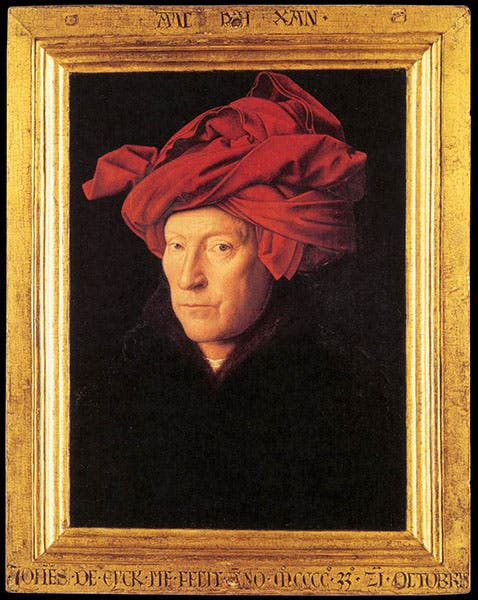
Man in a Turban, oil on wood, by Jan van Eyck, presumed self-portrait, 1433, National Gallery of Art, London (wga.hu)
.jpg#/media/File:The_Arnolfini_Portrait,_d%C3%A9tail_(2).jpg)
Detail of the central mirror in the Arnolfini Wedding, by Jan van Eyck, oil on panel, 1434 (Wikimedia commons)
We include van Eyck in our continuing rollcall of Scientists of the Day because of a single painting, if we may use the term for a work of art that survives in two versions. It is called St. Francis Receiving the Stigmata, and the version we show is the one in the Philadelphia Museum of Art (fourth image). It is small, just 5 x 5 ¾ inches, yet crammed with detail (the other version, larger but less detailed, is in Turin). The most remarkable element for us is a section of the painting that depicts a rock outcropping, including strata, boulders, stones, and even fossils (first image). It is accurate down to the smallest detail, and could only have been painted after an intimate study of a similar setting in nature. That may not sound like too much to ask from an artist, but the fact is, there is nothing like it in Western art before 1430, and, remarkably, not again for 350 years thereafter, even in the notebooks of Leonardo da Vinci. There are many, many examples of meticulous drawings of birds, beetles, and flowers from nature, by the likes of Albrecht Dürer, Joris Hoefnagel, and Rachel Ruysch, but no one turned a similar eye on rock formations until the 19th century. Possible exceptions might spring to mind, especially to those familiar with artists who have been labelled “world landscape” painters, such as Joachim Patinir, working a century after van Eyck. These painters were indeed fascinated by geological forms, and Patinir’s Saint Jerome in the Desert (1520) is a fine example of this fascination (last image). But the mountains and rock forms here are fantastic, not naturalistic, and so they are with all attempts to depict geological formations until the 19th century, and then it was geologists who took the lead, not artists.

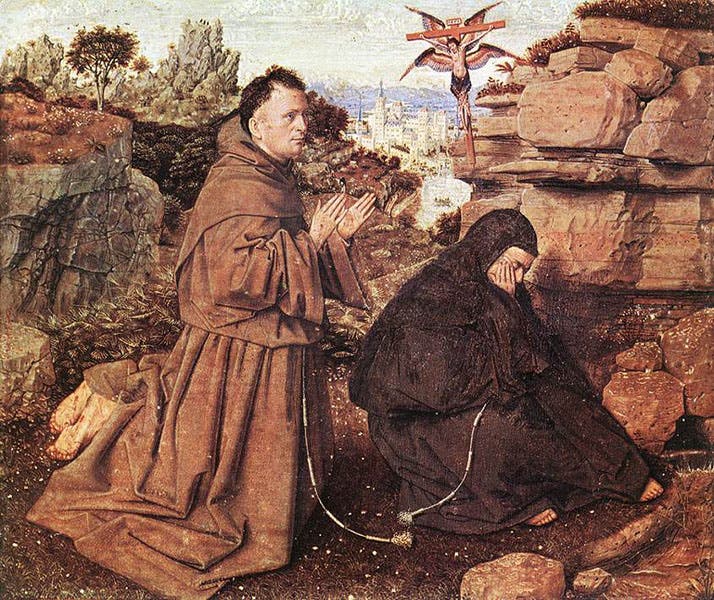
Saint Francis of Assisi Receiving the Stigmata, oil on wood panel, by Jan van Eyck, ca 1430, Philadelphia Museum of Art (wga.hu)
No one knows why this is so. Why did later artists not look at rock strata the way they looked at butterflies and daisies. But perhaps the more penetrating question is, why did van Eyck? Why did he do something – scrutinize a rock formation and draw it – that none of his predecessors and not one of his successors for three and a half centuries was interested in doing? What kind of mindset prevented artists, and natural scientists, from studying geological formations in detail for such a long time, van Eyck excepted? In the study of animals and plants, it was the artists who first looked closely at nature, and the naturalists who followed their lead. In the earth sciences, except for the study of fossils, that lead was missing, again with the exception of van Eyck. Perhaps that is why geology had to wait until 1795 for its own revolution, led by James Hutton, to get rolling.

Saint Jerome in the Desert, oil on panel, by Joachim Patinir, 1520, Louvre (Wikimedia commons)
There was a lengthy article by Scott Montgomery in Earth Sciences History, "The Eye and the Rock" (1996, vol. 15, pp. 3-24), that first drew my attention to the singular nature of van Eyck's painting of Saint Francis Receiving the Stigmata. We have that journal in the Library; the article is still well worth reading.
William B. Ashworth, Jr., Consultant for the History of Science, Linda Hall Library and Associate Professor emeritus, Department of History, University of Missouri-Kansas City. Comments or corrections are welcome; please direct to ashworthw@umkc.edu.



.jpg#/media/File:The_Arnolfini_portrait_(1434).jpg)