Scientist of the Day - Erasmus Darwin

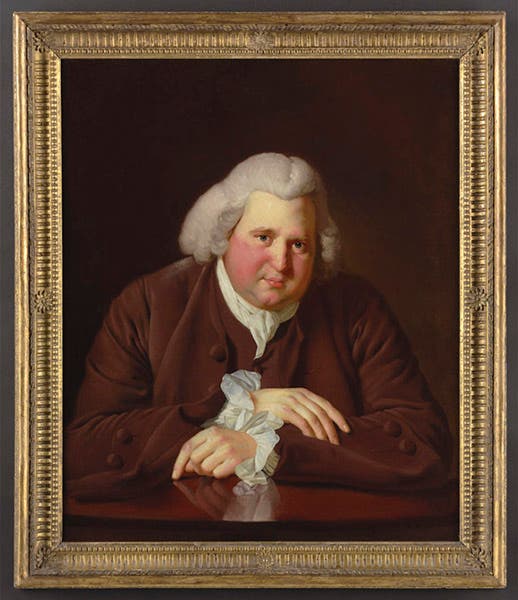
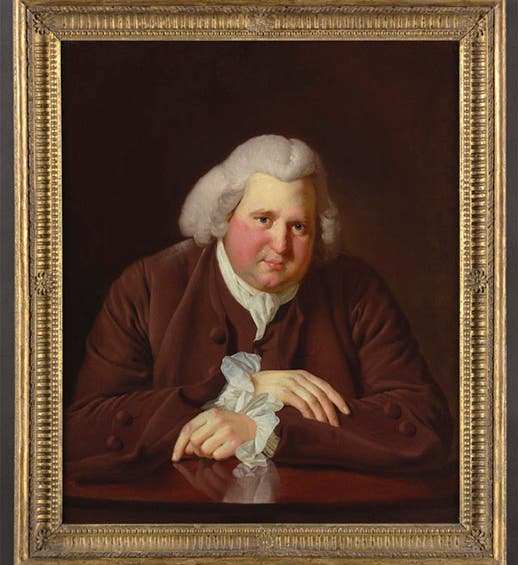
Portrait of Erasmus Darwin, oil on canvas, by Joseph Wright of Derby, 1770, Birmingham Museum and Art Gallery (arthistorynews.com)
Erasmus Darwin, English physician, poet, and paternal grandfather of Charles Darwin, was born at Elston Hall, the Darwin family estate, in Nottinghamshire, on Dec. 12, 1731. He studied at St. John's College, Cambridge, attended medical school at Edinburgh University, and then set up a medical practice in Nottingham, to which he failed to attract patients. So he moved south to Lichfield in Staffordshire to try again. This time, with the help of a cure of a boy's illness, the practice was successful, and he would ply his medical talent in Lichfield until 1781, when he moved to Derby.

Erasmus Darwin’s home in Lichfield, where he lived from 1758 to 1781; it is now a museum (Wikimedia commons)
Erasmus was full of curiosity, and he enjoyed learning about the technology that was beginning to shape the Industrial Revolution in the midlands. He made friends with inventive people, such as Matthew Boulton, a manufacturer (third image); Benjamin Franklin, a friend of Boulton and frequent visitor; Josiah Wedgwood, a potter; John Whitehurst, a geologist; and fellow physician William Small, newly arrived from Virginia. The arrival of Small (who taught Thomas Jefferson) in 1765 seems to have galvanized this gathering of mutual friends into forming a dinner circle that met once a month, at the full moon, so that they called themselves the Lunar Circle. James Keir, a chemist, joined in 1767. After 1775, when the group had grown with the addition of James Watt, Joseph Priestley, and William Withering, a physician, they began to call themselves the Lunar Society of Birmingham. They often dined at Boulton's home, Soho House, in Birmingham, although Darwin's house in Lichfield frequently hosted meetings as well. They met at the full moon so that the members from surrounding towns might have a safer passage home.

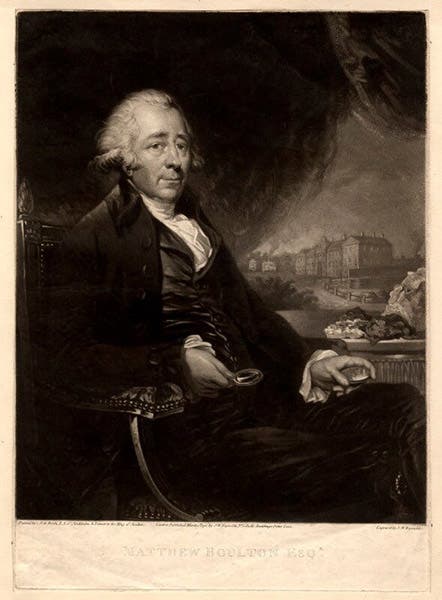
Portrait of Matthew Boulton, Erasmus Darwin’s oldest and closest friend in Lichfield, mezzotint by Samuel Reynolds after a painting by Carl Fredrik von Breda, 1796, National Portrait Gallery, London (npg.org.uk)
It is curious that Erasmus was an integral part of the Lunar Society. He was often described by contemporaries as coarse, given to over-eating and over-drinking, and there was the matter of the two illegitimate daughters, the "Misses Parker" that he sired, courtesy of a governess to his proper children (his wife had died in 1770), and whom he raised in the household and for whom he later set up a school for them to run. But his intelligence and curiosity must have prevailed, for he never lost the friendship of any of the lunar circle, or Franklin (who was not a member, but a frequent guest when in England), even after Erasmus moved to Derby and could no longer attend the monthly meetings. We have written a post on nearly every member of the Lunar Society of Birmingham, as you can see by the frequent links above (and below).

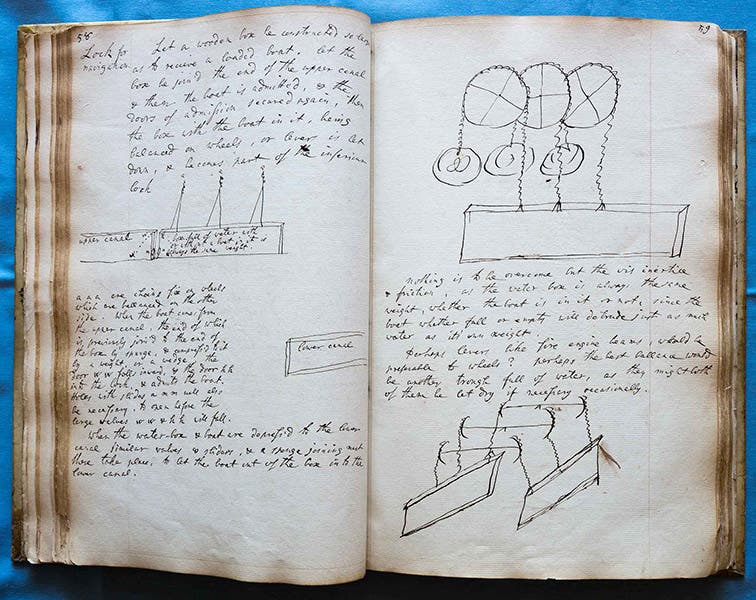
Two pages from Erasmus Darwin’s commonplace book, on display at the Erasmus Darwin House museum, Lichfield (erasmusdarwin.org)
One of Darwin's acquaintances was Joseph Wright of Derby, an accomplished artist and portrait painter. He lived too far away to attend the monthly dinners of the Lunar Society, but he is often considered a member, and since there never was any kind of a membership list, who is to say? He painted portraits of many of the members, and that includes Darwin, whom he painted at least twice, with multiple copies of each. We show the first of these today, painted in 1770 (first image); we will show the later portrait in our follow-up post on his life in Derby. Another artist who painted portraits of at least three Lunar Society members was Carl Fredrik von Breda, and we have written a post on von Breda as well.

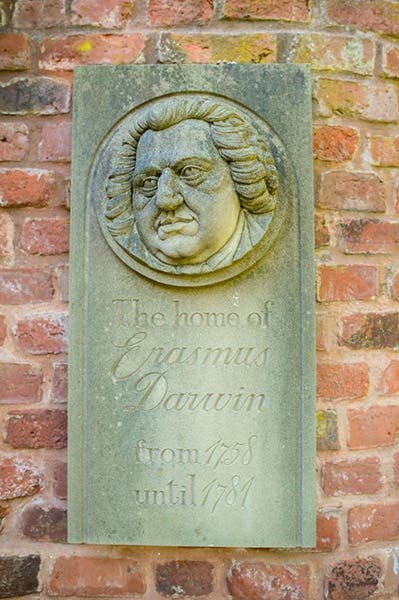
Carved stone plaque on the outside of the Lichfield home of Erasmus Darwin (erasmusdarwin.org)
Darwin remarried in 1781 and left Lichfield for Derby, where his new wife owned a house. It was during his Derby years that he began the literary phase of his career, publishing three books between 1789 and his death in 1802 (7 years before Charles Darwin was born). We will discuss these books, and Erasmus’s own evolutionary ideas, in a second post. We wrote a post on Erasmus back in 2014, during the first two months of this series, and like most of those initial attempts, it was too brief, and the images had no captions. So we are updating it with this post and a post yet to be written. But we will leave the first one in place. One must not tamper with the historical record.

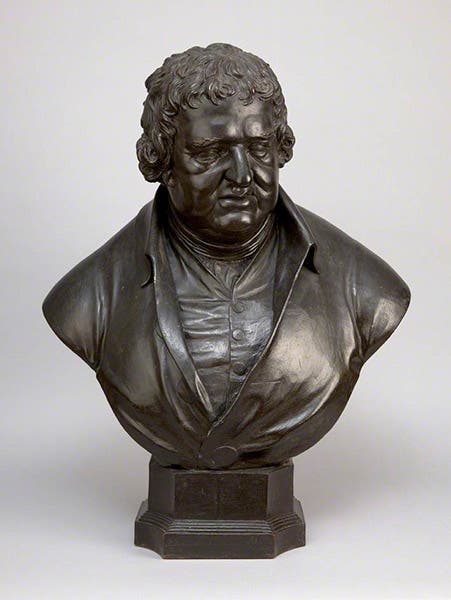
Bust of Erasmus Darwin, terracotta, sculpted by William John Coffee, undated but before 1846, English Heritage, on display at Down House, Kent (artuk.org)
Darwin's house in Lichfield is now the Erasmus Darwin House museum, which has on display one of the Wright portraits of 1770 (at least I assume so; it is on their web page, but with no caption). They also display a commonplace book belonging to Erasmus, from which we show a page (fourth image). I have no idea what kind of invention inspired these drawings, but I do like his style.
A book I very much enjoyed, when I first read it 20 years ago, is The Lunar Men: Five Friends whose Curiousity Changed the World, by Jenny Uglow (Farrar, Straus and Giroux, 2002); it is still my go-to book on matters concerning the Lunar Society of Birmingham.
William B. Ashworth, Jr., Consultant for the History of Science, Linda Hall Library and Associate Professor emeritus, Department of History, University of Missouri-Kansas City. Comments or corrections are welcome; please direct to ashworthw@umkc.edu.